

Quick Answer
What actually happens inside an automatic litter box between the cat leaving and the waste reaching the drawer?
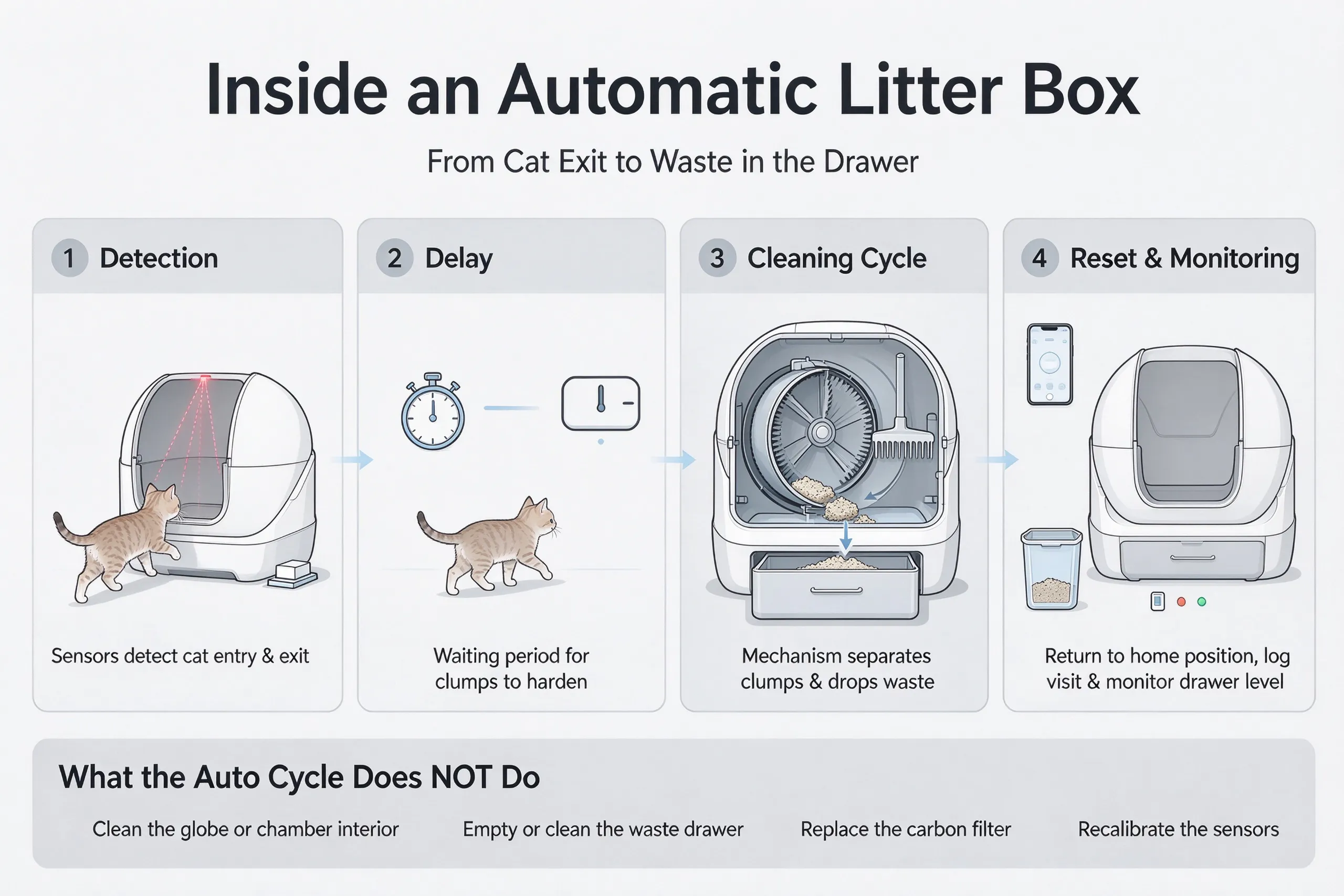
Sensors confirm a cat has entered and then exited the chamber. Most systems rely on weight load cells in the base, an infrared/laser curtain across the entryway, or a combination of both. Crucially, the system waits for the cat to fully exit before initiating any timer.
After exit confirmation, a user-configurable timer runs (typically 3–30 minutes) before the cleaning cycle starts. This delay serves two distinct functions: it ensures the cat has fully cleared the area, and it allows fresh clumps sufficient time to harden completely before mechanical sifting begins.
The physical mechanism activates — a globe rotates, a rake travels, or a conveyor belt moves — separating waste clumps from clean granules and depositing waste into a sealed drawer below. The specific drive mechanism dictates sifting efficiency, litter compatibility, and potential failure modes.
The mechanism returns to its baseline home position. Connected smart units log cycle completion in the companion app, update cat visit metrics, and engage Drawer-Full Indicator (DFI) sensors to track remaining capacity until human emptying is required.
How Owners and Independent Reviewers Describe the Mechanism (2024–2026):
“On a high level, the Litter-Robot is a rotating automatic litter box that relies on gravity to separate clumps from clean litter. The appliance’s patented design features a rotating globe with an integrated sifting mechanism that separates waste from clean litter.”
Engineering Assessment: "Relies on gravity" is the core mechanical distinction: rotation shifts the litter bed across a stationary screen, and gravitational pull performs the actual separation. Clean granules pass through the mesh openings, while intact waste clumps ride over the grate and fall into the collection drawer. The motor simply drives rotation; gravity executes the sifting.
“Regardless of the brand, almost all automatic litter boxes follow the same 'Detect-Wait-Clean' protocol. Step 1: Detection. Step 2: A timer manages the delay. Step 3: A drum rotates or a sifting mechanism moves.”
Why the 'Wait' Step Matters: The countdown timer is often overlooked by buyers but is critical for safety and litter performance. A cycle delay that is too short introduces two failure points: a cat that re-enters abruptly may encounter moving parts, and an unhardened clump will shatter across the sifting screen, contaminating clean substrate.
“The most sophisticated automatic litter boxes use multiple detection systems simultaneously. A timer manages the delay between detection and cleaning cycle activation.”
Dual-Sensor Architecture: Simultaneous detection (base weight scales plus curtain laser arrays, as seen in OmniSense) prevents accidental cycles. Because both sensory systems must verify the cat has cleared independently, the architecture completely eliminates single-point failures where a single faulty sensor could trigger premature rotation.
Step 1: Detection — How the Box Knows When Your Cat Has Left
Detection is the foundational engineering problem of automatic litter box design: the mechanism must know precisely when a cat is present (no cycle should run) and when the cat has fully exited (cycle can begin after the delay). Getting this right — reliably, across cats of different weights and sizes, in dusty litter environments that degrade sensors over time — is the engineering challenge that separates reliable units from unreliable ones.
Weight Sensors: How Load Cells Detect Cat Presence
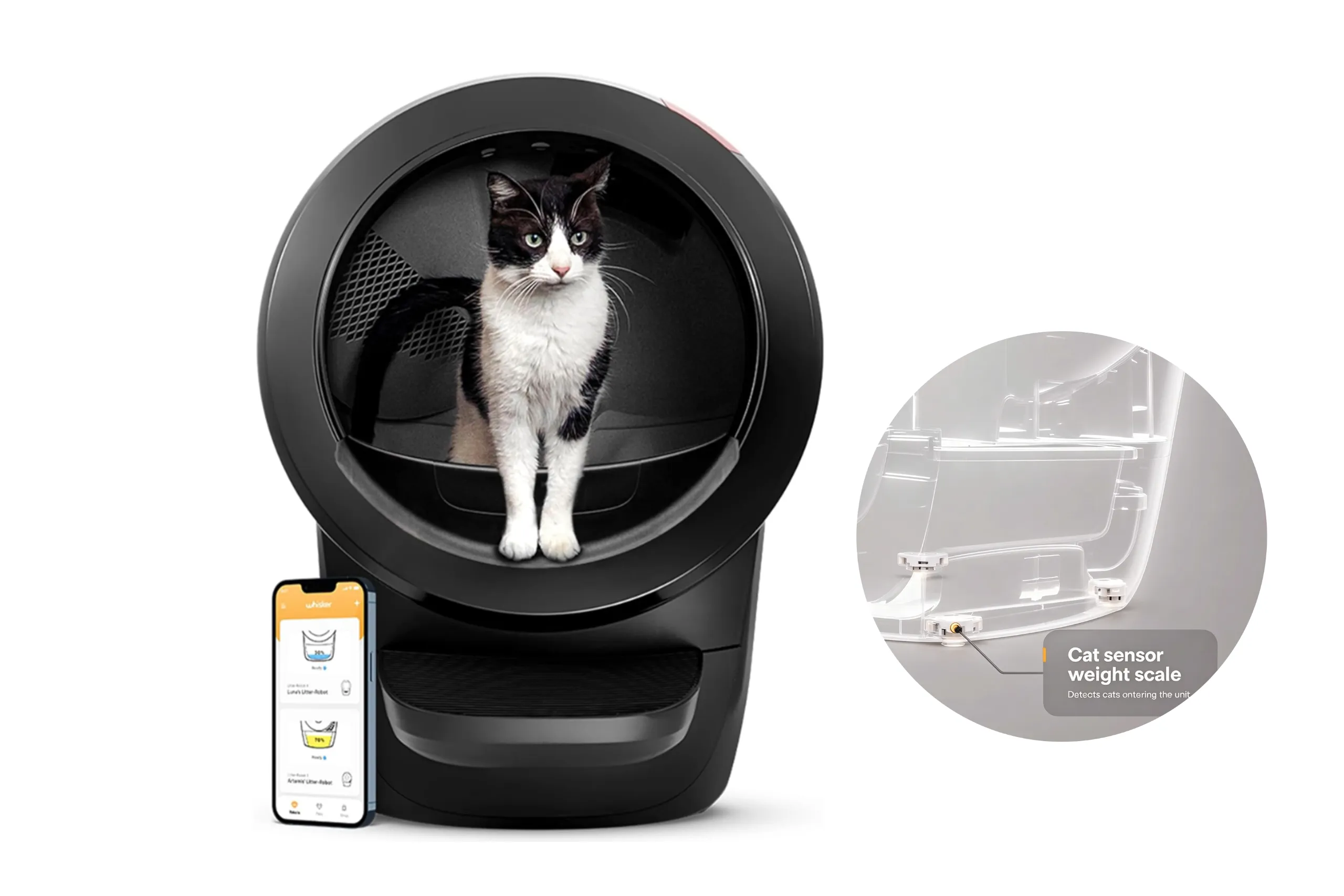
Weight-based detection uses load cells — force transducers — embedded in the base of the unit. The load cells register a change in weight when a cat enters the globe: the baseline weight of the litter bed increases by the cat’s body weight. When the cat exits, the weight returns to baseline. The system logs entry, exit, and the cat’s approximate weight (calculated from the difference between litter-bed weight and total weight).
Weight sensors have a minimum detection threshold — a weight below which the sensor cannot reliably distinguish a cat’s presence from normal litter mass variation. The Litter-Robot 4’s threshold is approximately 3 lbs; the Litter-Robot 5 lowers this to approximately 2 lbs. Cats below the threshold — kittens, small or underweight adult cats, elderly cats who have lost muscle mass — may not reliably trigger the sensor, which can allow the cleaning cycle to begin while the cat is still inside. This is the primary safety consideration for owners of small cats, covered in detail in our guide to whether self-cleaning litter boxes are safe.
Curtain Laser Sensors: Beam Interruption as a Secondary Detection Layer
Curtain laser sensors use infrared or visible laser beams projected across the entry opening of the globe. When a cat passes through the beam, it interrupts the light path, registering a detection event. Three curtain laser sensors in the bezel of the Litter-Robot 4 — documented in Whisker’s official sensor documentation — create a detection ‘curtain’ across the full entry width, rather than a single beam that could be bypassed by a cat entering at an angle.
In the LR4’s OmniSense system, the weight sensors and curtain laser sensors operate simultaneously. The cycle does not begin until both sensor types have registered the cat’s exit. This redundancy is the fail-safe architecture: a single sensor malfunction (weight sensor fouled by litter residue, laser lens obscured by dust) does not alone trigger a cycle, because the second independent system has not cleared. In budget single-sensor designs, a single sensor failure produces a single point of failure — the unit either cycles prematurely or fails to cycle at all, depending on whether the failure mode is false-positive or false-negative.
Step 2: The Delay Timer — Why It Exists and What Happens If It's Too Short
The delay between exit detection and cycle start is not arbitrary — it serves two distinct engineering functions that are easy to miss. Most owners think of the delay only in terms of letting the cat leave the area before the mechanism startles them. The second function is equally important: it gives the litter clump time to finish forming.
The Two Functions of the Cycle Delay
Function 1 — Cat clearance time: after the sensors register exit, the cat may be immediately adjacent to the box or may re-enter within seconds. A delay ensures the cat has moved away and is not in a position where the mechanism starting would startle or trap it. The minimum recommended delay for most designs is 3 minutes. For senior cats who exit slowly or re-enter quickly, 15–20 minutes is more appropriate.
Function 2 — Clump formation time: sodium bentonite clumping litter forms clumps through an exothermic crystallisation process that continues for several minutes after urination. A clump that has been forming for 2 minutes is softer and more fragile than one that has been forming for 7 minutes. If the sifting mechanism acts on a partially-formed clump, the clump crumbles during separation and distributes urine-soaked fragments throughout the clean litter bed — exactly the residue problem that produces background odour even in a regularly-cycled box. The 7-minute default delay in the Litter-Robot 4 is calibrated to allow adequate clump formation for standard-weight sodium bentonite litter; lighter litters that form slower clumps may benefit from a longer delay setting.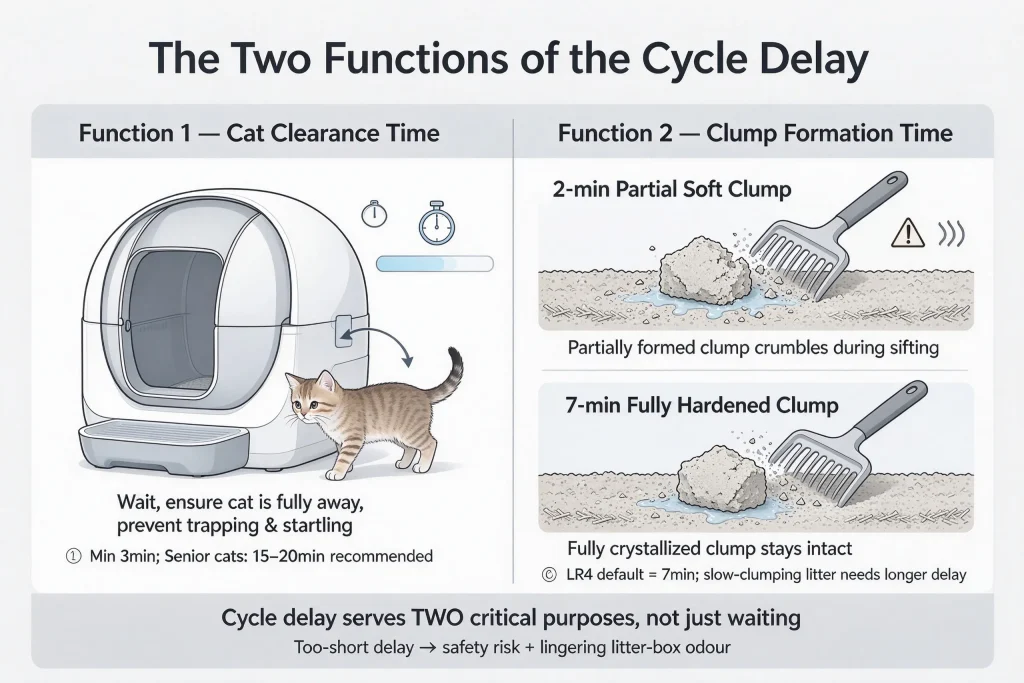
Sleep Mode and Manual Delay Override
Most connected automatic litter boxes allow the cycle delay to be configured via the app — from as short as 3 minutes to as long as 30 minutes in the Litter-Robot 4. Sleep Mode is a separate feature that disables automatic cycling entirely during a configured overnight window, preventing any cycle from starting between specified hours regardless of cat activity. This is covered in detail in our guide to quiet litter boxes, where it is discussed as a solution for bedroom placement.
Step 3: The Cleaning Mechanism — How Each Design Type Works
The cleaning mechanism is the physical heart of the automatic litter box. Three main mechanism types exist in the consumer market, each with a distinct operating principle, litter compatibility profile, and failure mode. Understanding which mechanism a unit uses is the first specification question to answer when evaluating any automatic litter box.
Mechanism Type | Operating Principle | Litter Requirement | Primary Advantage | Primary Failure Mode |
Globe-style rotating (e.g. Litter-Robot 4, PETKIT Pura Max) | The entire globe chamber rotates. Clean litter granules fall through a fixed screen as the globe rotates; waste clumps (too large to pass through the screen) ride over the screen and drop into the waste drawer below through a waste port. Gravity does the separation; the motor drives the rotation. | Standard-weight sodium bentonite clumping clay only. Litter grain must be smaller than the screen mesh; clump must be larger and firm enough to survive rotation intact. | Clean separation when litter and settings are correct; no rake track to accumulate residue; quieter motor design possible (continuous rotation vs reciprocating motion) | Litter compatibility — incompatible litter types pass through the screen or fail to form intact clumps; screen clogging from wet or fine-grain litter; globe misalignment |
Rake-style / comb (e.g. PetSafe ScoopFree, LitterMaid) | A motorised comb or rake travels across a flat litter bed, pushing waste clumps forward into a covered waste compartment at one end. The rake returns to the home position after depositing waste. | Clumping litter; any standard-weight clumping type generally compatible. Crystal litter variants use a different mechanism (rake pushes through crystals, which absorb rather than clump). | Wider litter compatibility than globe-style; simpler mechanism with fewer components; well-understood failure modes | Rake track accumulates residue over time (urine caked on track); rake jamming from oversize clumps or foreign objects; waste compartment less sealed than drawer designs |
Belt / conveyor (e.g. some CatGenie variants) | A motorised belt or conveyor moves waste across the litter bed surface. Less common than rake or globe designs. CatGenie uses a granule-washing system rather than a conventional belt. | Design-specific — CatGenie uses washable plastic granules (not standard litter); belt designs vary | Design variants possible for specific niche requirements (washable granule system eliminates litter purchase cost) | Proprietary consumables (CatGenie granules); mechanism complexity; less available in standard OEM supply |
Wheel / drum rotating (less common) | A rotating drum or wheel sifts litter in a motion similar to the globe but with a different chamber geometry — typically a horizontal axis rather than the globe’s off-centre rotation. | Clumping litter; specific compatibility depends on screen design in the drum | Compact design possible; fewer moving parts than globe-style in some implementations | Less validated in the premium market; limited independent testing data available |
How Globe-Style Gravity Separation Works: The Engineering Detail
The globe-style mechanism is the most widely reviewed and best-documented design in the category. Cats.com’s mechanism explanation describes it accurately: the globe relies on gravity to do the separation. What this means mechanically: when the globe rotates, the litter mass inside moves relative to the fixed sifting screen. Litter granules — which are smaller than the screen openings — fall through the screen and collect in the lower clean-litter section. Waste clumps — which are larger and more cohesive than individual granules — cannot pass through the screen and continue moving with the rotating globe until they reach the waste port at the bottom of the rotation, where they drop into the waste drawer below.
Step 4: Odour Containment — What the Drawer System Does
The odour containment system is the component most directly responsible for the room-level odour experience that drives most automatic litter box purchase decisions. As our litter box odor control guide explains, the sealed waste drawer’s function is to remove waste from the litter bed quickly (reducing ammonia accumulation in the litter) and contain it in a sealed compartment (reducing ambient room odour). Understanding how the drawer system works explains both its performance ceiling and its maintenance requirements.
The Sealed Waste Drawer: How Odour Containment Works
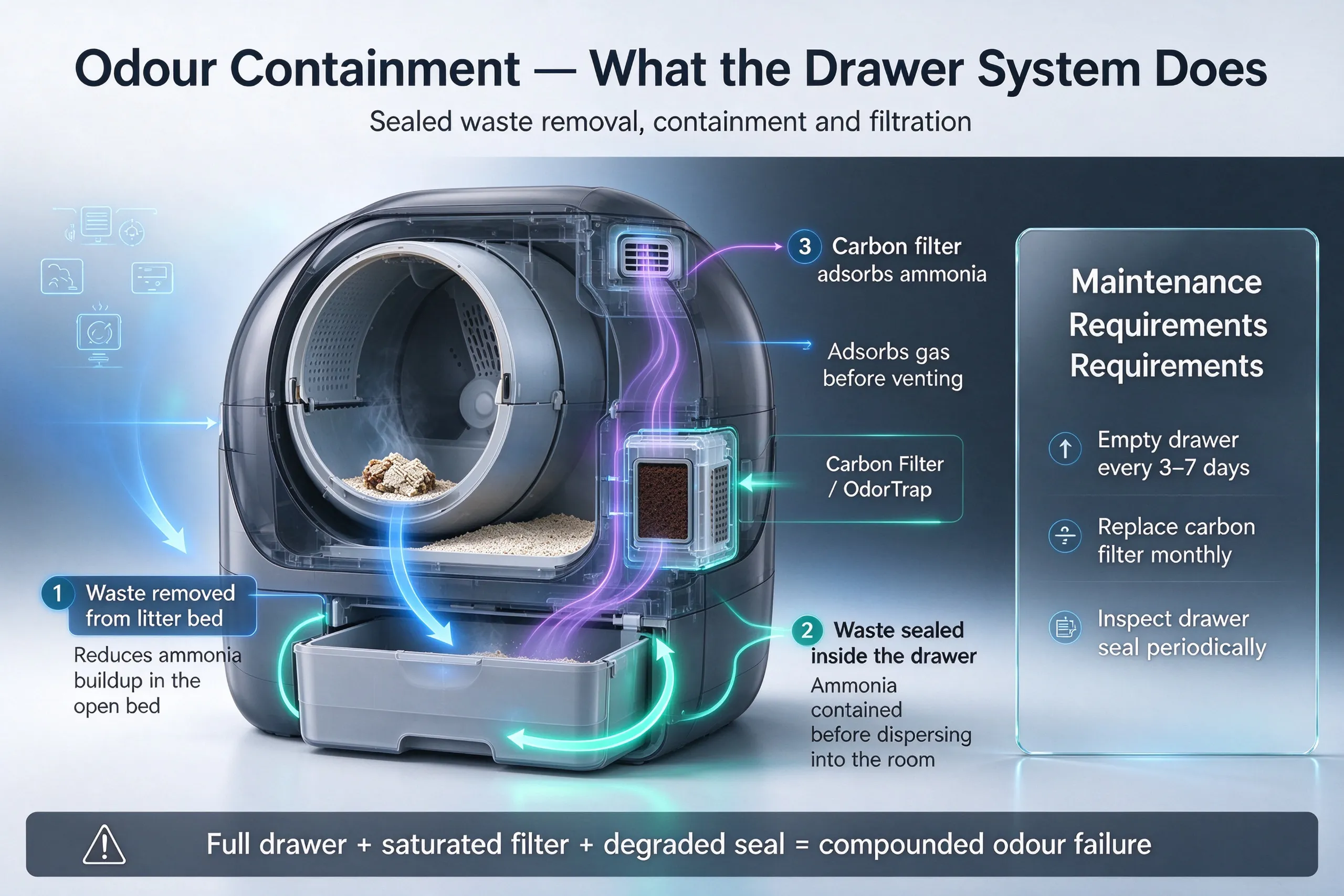
Waste deposited from the cleaning cycle lands in the waste drawer — a removable tray below the globe or mechanism chamber. A door or seal closes the drawer entry between cycles. The carbon filter or OdorTrap pack sits in or near the drawer, adsorbing ammonia gas as it passes from the drawer interior toward the vent. The combined effect is: 1) waste removed from the open litter bed quickly (less ammonia produced in the room), 2) waste sealed inside the drawer (ammonia that forms inside the drawer is contained rather than dispersing into the room), and 3) carbon filter adsorbs ammonia that passes through the seal toward the vent.
The critical maintenance implication: the waste drawer is not self-emptying. It must be manually emptied on a schedule (every 3–7 days depending on cat count), the carbon filter must be replaced monthly, and the drawer seal must be inspected periodically. A full drawer, a saturated filter, or a degraded seal each independently degrade the odour containment system — and their effects compound. An owner running all three overdue simultaneously is getting essentially no odour containment from a system designed to provide it.
The Connectivity Layer: What App Integration Actually Does
Connected automatic litter boxes add a software layer on top of the physical mechanism: an app that logs usage data, allows remote configuration, and provides health monitoring. For most owners, the app is an optional convenience. For owners of senior cats or multi-cat households, it becomes a genuinely useful health monitoring tool.
What the App Logs and Why It Matters
Every cleaning cycle in a connected automatic litter box produces a usage event: the cat’s entry time, exit time, estimated duration of use, and (in weight-tracking units) estimated cat weight at the time of the visit. These events accumulate into a visit history that builds a baseline for each cat over days and weeks. Deviations from that baseline are the clinically relevant signal: a sudden increase in visit frequency with shorter duration per visit, for example, is associated with early urinary tract disease in the veterinary literature — and it shows up in app data days before it becomes visible to an owner watching the box.
In multi-cat households, the app’s ability to distinguish individual cats by weight is the feature that makes health monitoring actionable. In a household with two cats of significantly different weights, the app can attribute each visit to the correct cat with reasonable accuracy, allowing the owner to track whether the behaviour change is in one specific cat or in both. Our guide to self-cleaning litter boxes for multiple cats covers this attribution accuracy in more detail, including the minimum weight difference needed for reliable individual identification.
What Automatic Litter Boxes Don't Do: The Limits of the Mechanism
Understanding what the automatic mechanism does not do is as important as understanding what it does — because the most common sources of owner disappointment at 6–12 months are expectations the mechanism was never designed to meet.
What It Does NOT Do | Why Not | What Addresses This Instead |
Clean the globe or chamber interior | The cleaning cycle moves litter and waste — it does not apply cleaning agents or scrub surfaces. Uric acid and bacterial residue accumulate on the interior surface over time. | Monthly enzyme cleaner deep clean by the owner — the subject of our cleaning guide |
Empty the waste drawer | The drawer is a passive receptacle. The mechanism deposits waste into it; no automatic system removes waste from the drawer. | Manual emptying every 3–7 days depending on cat count |
Replace the carbon filter | The filter is a consumable component with a finite adsorption capacity. The mechanism has no filter-replacement function. | Monthly filter replacement by the owner |
Eliminate all litter box odour | The mechanism reduces ambient room odour by removing waste quickly and sealing it in the drawer. It does not eliminate the odour that forms inside the drawer, the odour released when the drawer is opened, or background odour from bacterial colonisation of the interior surface. | Correct maintenance schedule + filter replacement + enzyme deep clean |
Work with all litter types | The sifting screen is calibrated for standard-weight sodium bentonite clumping litter. Other litter types fail in predictable ways. | Use of compatible litter — covered in our best litter for automatic litter boxes guide |
Replace a veterinary visit when a cat’s behaviour changes | Health monitoring data from the app flags deviations from a cat’s baseline — it does not diagnose the cause. Any significant change in visit frequency, duration, or weight trend warrants a veterinary evaluation. | Veterinary consultation; app data used as supporting information, not diagnosis |
Do Automatic Litter Boxes Actually Work? The Honest Assessment
The mechanism described in this article works reliably when operated within its design parameters: compatible litter at the correct depth, adequate waste drawer emptying frequency, monthly filter replacement, and regular sensor maintenance. Under these conditions, automatic litter boxes do what they are designed to do — they remove waste from the litter bed quickly after each use and contain it in a sealed drawer, producing better ambient room odour than a manually-scooped box on any realistic schedule. For the full value-decision assessment — whether this mechanism justifies the cost and running expense for a specific household — see our guide to whether self-cleaning litter boxes are worth it. For the complete evaluation of which specific model is right, see our best self-cleaning litter box guide.
The Manufacturer's Perspective: The Three Mechanism Decisions That Determine Long-Term Performance
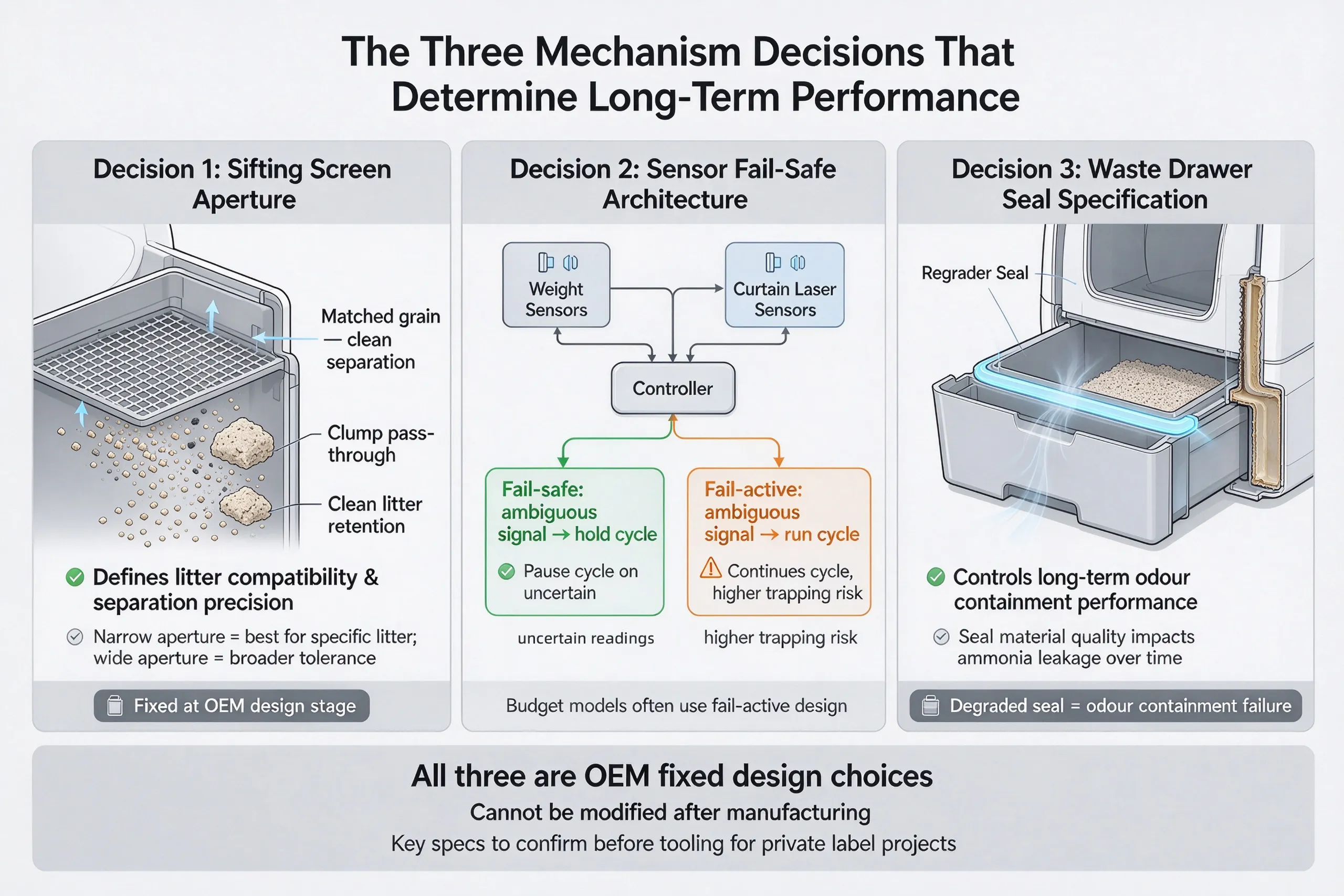
After 16 years of designing and manufacturing automatic litter box mechanisms, the three specification decisions that most determine long-term performance are the sifting screen aperture, the sensor fail-safe architecture, and the waste drawer seal specification. All three are fixed at the OEM design stage and cannot be meaningfully modified post-production. All three are invisible in product listings and almost never evaluated in consumer reviews.
The sifting screen aperture is the specification that determines litter compatibility range. A screen calibrated for a narrow grain-size range produces excellent separation with the target litter type and poor performance with any deviation from it. A screen with a wider aperture tolerance accepts more litter types but provides less precise separation — more ‘pass-through’ of partially-formed clumps and more ‘retention’ of clean litter granules. The engineering tension is real, and the correct calibration depends on the specific litter type the manufacturer intends to position as the recommended litter for that product.
The sensor fail-safe architecture — documented in the Evidence Check above — is the safety-critical specification that most directly affects consumer trust in the category. A fail-safe default state (cycle holds when sensor reading is ambiguous) produces the occasional false-positive error (cycle doesn’t start when it should) as its failure mode. A fail-active default state (cycle proceeds when sensor reading is ambiguous) produces the occasional false-negative error (cycle starts when a cat might be present) as its failure mode. The asymmetry in consequences should make the correct choice obvious; yet budget designs frequently use fail-active defaults to minimise false-positive user complaints at the cost of elevated safety risk.
The waste drawer seal specification determines long-term odour performance — covered in the evidence layer of our OEM vs ODM guide for litter boxes. For brands sourcing private-label automatic litter boxes: these three specifications — screen aperture, sensor fail-safe architecture, and drawer seal material — are the OEM design decisions with the largest impact on long-term product performance and customer satisfaction. All three should be documented in writing in the product specification before tooling begins.
Frequently Asked Questions
Every self-cleaning litter box follows four steps: 1) Detection — sensors (weight-based, infrared laser, or both) identify when a cat has entered and exited the box. 2) Delay — a configurable timer (typically 3–30 minutes) runs after exit detection to allow the cat to move away and allow clumps to finish forming. 3) Cleaning cycle — the mechanism runs: a globe rotates to sift litter via gravity separation, a rake travels across a flat litter bed to push waste into a compartment, or a belt conveys waste. Clean litter is retained; waste clumps are deposited in a sealed waste drawer. 4) Reset and monitoring — the mechanism returns to home position; connected units log the visit in the app; the drawer-full indicator monitors waste level. The box is ready for the next use without any owner intervention.
Yes — within their design parameters. An automatic litter box reliably removes waste from the litter bed within minutes of each cat visit and contains it in a sealed waste drawer, producing better ambient room odour than a manually-scooped box on any realistic once-daily schedule. The conditions required for reliable operation are: compatible clumping litter at the correct depth (3–4 inches), waste drawer emptied every 3–7 days, carbon filter replaced monthly, and sensor maintenance (lens cleaning and recalibration) performed as needed. Units operated outside these parameters — incompatible litter, deferred maintenance, sensors not calibrated — produce the unreliable performance and odour complaints that drive negative reviews. The mechanism works; operating it correctly is what determines whether a specific household's experience is positive.
Most automatic litter boxes — particularly globe-style designs like the Litter-Robot 4 — require standard-weight, fast-clumping sodium bentonite clay litter. The sifting screen is calibrated for the grain size and clump characteristics of this litter type: granules small enough to fall through the screen as clean litter, clumps large and firm enough to ride over the screen intact and deposit cleanly into the waste drawer. Incompatible types include lightweight clumping litters (granules may pass through the screen into the waste drawer), silica crystal litters (pass through the screen; no clumps form), wood or paper pellets (grain size too large; no clumps), and non-clumping litters (no waste-grain separation possible). See our guide to the best litter for automatic litter boxes for specific brand compatibility analysis.
The Litter-Robot 4 uses the OmniSense detection system — four weight sensors in the base plus three curtain laser sensors in the bezel, operating simultaneously. The weight sensors register the cat's presence by the change in litter bed weight when the cat enters, and register exit when the weight returns to baseline. The curtain laser sensors create a beam across the globe entry opening; the cat's body interrupts the beam during entry and exit. Both sensor types must register the cat's exit before the cycle delay timer starts. This dual-sensor architecture means a single sensor malfunction cannot alone trigger a premature cleaning cycle — both systems must agree before anything happens. The OmniSense sensors require recalibration after the unit is moved, after a significant litter refill, or after a firmware update to maintain accuracy.
The four most common causes of a missed cleaning cycle: 1) Sensor detection failure — the sensors did not register the cat's exit, either due to calibration drift (recalibrate via the app) or lens contamination (clean curtain sensor lenses with a dry cloth). 2) Cycle delay still running — the unit is in the delay phase between exit detection and cycle start; this is normal. 3) Sleep Mode is active — if overnight Sleep Mode is enabled, no cycles run during the configured window. 4) A cycle error has paused the unit — check the app for any error codes or light bar status indicating the unit needs attention. If the unit's LED shows a non-blue light (yellow, red, or flashing), the unit has encountered an error that requires investigation before it will resume automatic cycling. Our troubleshooting guide covers the full diagnostic sequence for missed cycles and error codes.




