Are self-cleaning litter boxes safe for cats?
For most healthy adult cats, yes — with an essential qualification regarding mechanical architecture and cat suitability. Documented injuries are real but stem almost exclusively from a specific design flaw rather than the category as a whole.
Established Multi-Sensor Units
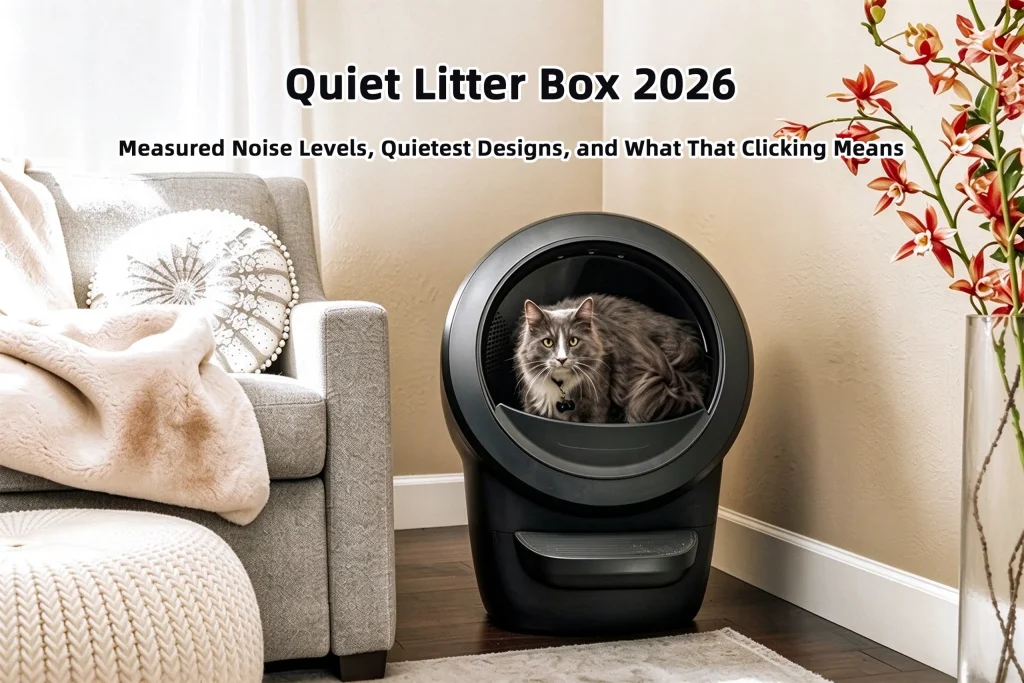
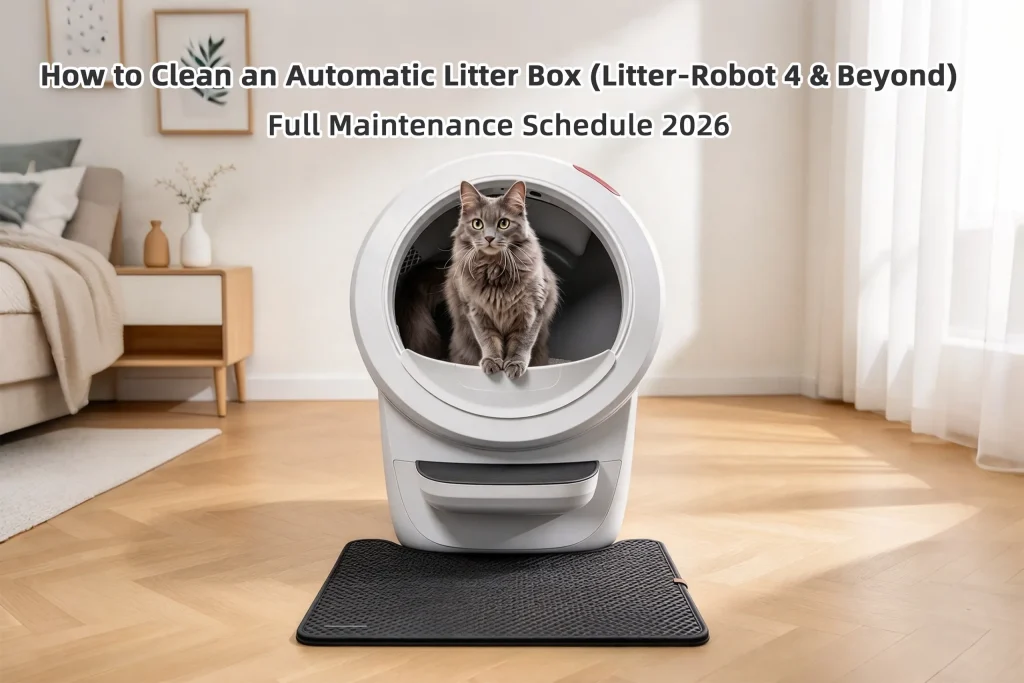
Models like the Litter-Robot 4/5 and PETKIT Pura Max maintain strong safety records. They employ redundant multi-sensor arrays (weight + radar/infrared) and keep the opening accessible throughout the rotation, preventing entrapment.
High-Risk Unbranded Drums
Reported fatalities and injuries came almost exclusively from cheap, unbranded rotating-drum designs featuring a single-point sensor and a closing entrance. When the single sensor fails, the rotating aperture creates a mechanical trap.
Three Categories of Cats NOT Suitable for Automatic Boxes:
- 1. Kittens Under 5 lbs Too light to reliably trigger standard weight sensors, risking premature cycle activation while the kitten remains inside.
- 2. Anxious / Timid Cats Prone to severe stress or Pandora syndrome from mechanical motor sounds, sudden movements, or enclosed globe chambers.
- 3. Mobility-Limited Cats Senior cats with arthritis, tripod cats, or post-op pets struggle with typical 12–15 inch high sills and slower exit times.
What Owners and Reviewers Report About Safety
Community safety threads, independent lab reviews, and veterinary consultations (2024–2026)
“A Siamese cat named Mochi was killed when the device closed on its neck. Another user reported a 3-month-old kitten named Charly was killed in the same manner.”— Sphynxlair Community Safety Thread (Feb 2026)
Both fatalities involved an unbranded rotating unit with a single small entrance hole that created a mechanical shear/guillotine point when the single sensor failed to register the pet.
“In June 2025, a NYC woman reported her cat, Sarabi, was crushed to death by an Autoscooper 11, leading to a $3 million lawsuit against the manufacturer.”— Sphynxlair Incident Report (Feb 2026)
Shares the identical root mechanism: reliance on an isolated sensor without redundant backup, failing to halt mechanism rotation before contact occurred.
“Documented injuries from Whisker Litter-Robot models are rare and are typically associated with cats under the weight floor or with users disabling the safety sensors.”— Petful.com Independent Safety Review (May 2026)
Established brands utilize open-entry chambers with dual detection (weight + radar/infrared). A single blocked sensor triggers a fail-safe hold rather than an active cycle.
The Core Diagnostic: Serious safety incidents are design-specific, not category-wide. They trace back to cheap, unbranded rotating drums featuring single-point sensor dependencies and closing entry apertures.
Not All Automatic Litter Boxes Have the Same Safety Profile
The automatic litter box category spans a wide range of safety standards, and understanding this range is the most important context for the safety question. ‘Are automatic litter boxes safe?’ is not a question with a single yes or no answer — it is a question that requires knowing which type of box is being asked about. The safety record of established, multi-sensor units and cheap unbranded rotating-drum units are not comparable.
Category 1: Established Multi-Sensor Designs
Units from manufacturers who publish their safety specifications — weight sensors, infrared or radar motion detection, pinch protection, delayed cycle start — and have a multi-year track record in market have documented safety records. The key technical property is redundancy: a sensor system where two independent detection methods must both clear before the cleaning cycle begins. If either sensor detects a cat, the cycle halts. This redundancy means a single sensor failure — dust accumulation on an infrared sensor, for example — does not create an immediate hazard because the second detection method is still active.
These designs also share an architectural property that prevents the most severe injury mechanism: the entry opening remains open during the cleaning cycle. A globe-style unit that rotates with its opening fixed upward throughout the cycle cannot trap a cat inside in the way that a design with a mechanical door can. Petful.com’s 2026 safety review of the category explicitly identifies this as the primary design differentiator: avoid any box where the entry closes mechanically during the cleaning cycle, as that closure mechanism is the primary failure mode in the units responsible for documented injuries.

Category 2: Single-Sensor Rotating-Drum Designs — The Risk Profile
The incidents documented in online safety threads and the Sphynxlair community warning (Feb 2026) share a common design: a rotating inner chamber with a single, small entrance hole — typically a circular or star-shaped opening that rotates with the drum. When the drum rotates and the sensor has failed to detect the cat, this entrance acts as a mechanical trap. The documented injuries describe a ‘guillotine’ effect when the entrance edge contacts a cat that is partially inside or exiting as the rotation begins.
These units are typically sold under generic or frequently-changing brand names on Amazon and other e-commerce platforms. They are priced significantly below established brands (often under $100), they do not publish safety datasheets, and they rely on a single infrared beam that is easily blocked by litter dust within days of first use. The TheRefinedFeline’s independent review (Mar 2026) documented this failure mode with a demonstration: the reviewer’s hand was trapped painfully within the mechanism during a sensor-pause test, and the pause was too brief for safe exit before the cycle resumed. The unit had shipped without its firmware safety update applied and without any notification to install it.
The Four Safety Features Every Unit Must Have
Before any cat uses an automatic litter box, confirm the unit has all four of the following safety features documented by name in the manufacturer’s published specifications. A unit that doesn’t publish these, or that describes them vaguely, should be treated with caution regardless of price or brand recognition.
The Four Safety Features Every Automatic Litter Box Must Have
Verify that all four systems are explicitly documented in the manufacturer's specification datasheet before purchase.
| Safety Feature | What It Does | Why It Matters | Red Flag If Absent |
|---|---|---|---|
| Dual-Sensor Detection Weight + Infrared / Radar | Two independent detection methods track feline entry and exit. The cycle only initiates when both sensors have fully cleared. | Single-sensor architectures have a catastrophic single point of failure; dust coating an optical sensor or a lightweight cat can trigger premature cycling. | Warning Sign: The product listing only specifies generic "smart sensors" or mentions only one detection technology without redundancy. |
| Open-Entry Design Accessible Chamber | The entry portal remains physically open and unobstructed to the cat throughout the cleaning rotation. | Documented feline fatalities stem almost exclusively from closing drum entrances that create mechanical shear points when sensors fail. | Warning Sign: Operation videos show the entrance door closing, rolling upside down into an inaccessible chamber, or featuring a narrow circular/star-shaped opening. |
| Configurable Cycle Delay Minimum 3 Minutes | The mechanism pauses for a predetermined buffer window after detecting the cat's exit before initiating rotation. | Curious cats frequently step out and re-enter immediately; a minimum 3-minute delay ensures the pet has fully departed the zone. | Warning Sign: Fixed instant-clean cycles (under 3 minutes), no app/hardware delay adjustment options, or unstated cycle timing. |
| Immediate Halt & Manual Override Emergency Pinch Stop | Rotation stops instantly if a cat touches or approaches the entrance mid-cycle; allows the owner to manually freeze motion at any moment. | Even premium sensors can experience corner cases; an instant motor brake and user override prevent physical contact and entrapment. | Warning Sign: The sensor only "pauses" motion briefly and auto-resumes after seconds without human confirmation, or lacks a physical stop button. |
Which Cats Are — and Aren't — Suitable for Automatic Litter Boxes
Even a well-designed automatic litter box with all four safety features is not the right choice for every cat. Three specific profiles present genuine suitability concerns that are not addressed by better sensor design or safer mechanisms — they are about the cat’s size, health, or temperament, not the machine’s design.
Kittens Under 5 lbs: The Weight Sensor Floor
Most automatic litter boxes use weight-based sensors to detect when a cat has entered and exited. These sensors have a minimum detection threshold. The Litter-Robot 4 and Litter-Robot EVO have a weight floor of approximately 3 lbs; the Litter-Robot 5 and 5 Pro lower this to 2 lbs. Most kittens under 10–12 weeks fall below even the lower threshold and cannot reliably trigger the sensor — meaning the box may cycle while the kitten is still inside because the sensor does not register them.
TechnoMEOW’s kitten safety guide (Feb 2026) places the safe introduction age at 5–6 months and 5 lbs minimum weight for most models. Before this point, the recommendation is to use the automatic box in manual-only mode (disconnected from automatic operation) or to use a traditional shallow-sided box for litter training. Introducing a kitten to an automatic box before they are reliably detectable also risks creating anxiety around the box during the critical litter-training period, potentially producing avoidance that persists into adulthood.
Senior and Mobility-Limited Cats: Entry Height and Cycle Timing
For most senior cats, automatic litter boxes offer genuine health benefits: consistent cleanliness reduces the ammonia exposure that can exacerbate respiratory conditions, and health-monitoring features in app-connected units track visit frequency and duration — changes that can indicate urinary tract issues, kidney disease, or diabetes days before a human owner would otherwise notice. Petful.com’s senior cat guidance (May 2026) notes that automatic boxes can actually be safer for senior cats than traditional boxes, particularly for health monitoring purposes.
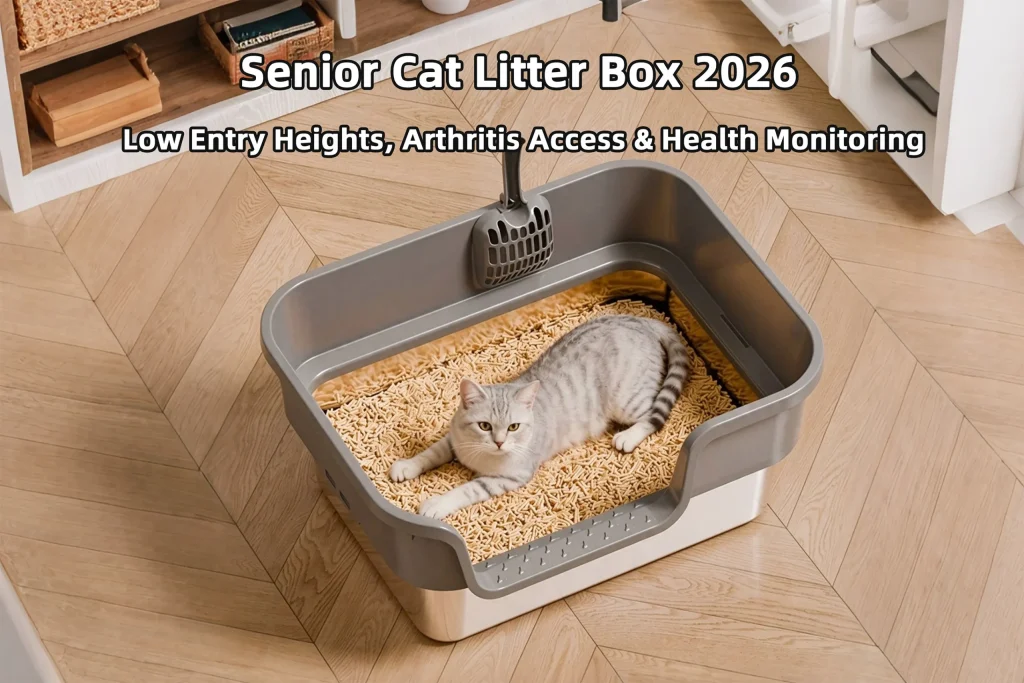
The concern specific to senior cats is entry height and mobility. Most globe-style automatic boxes have an entry sill of 12–15 inches from the floor. For a cat with arthritis, hip dysplasia, or post-surgical mobility limitations, stepping over a 15-inch sill may be painful or impossible. CATLINK’s senior cat guide (Apr 2026) identifies entry height under 3 inches as generally senior-friendly. Ramp accessories exist for several models. Veterinary guidance from CNN Underscored (Jan 2026) recommends that owners of senior cats consult their vet before introducing any automatic box — particularly because the cycle timing delay should be extended for cats who take longer to enter, position, and exit. A 14-year-old cat with stiff hips exits more slowly than a healthy adult, and a default 3-minute delay may not provide enough time.

Anxiety-Prone and Enclosed-Space-Averse Cats: When Open-Top Is the Only Safe Choice
Cats with a history of avoiding covered or hooded litter boxes, hiding in unusual locations, or displaying other stress behaviours around confined spaces are poor candidates for enclosed globe-style automatic boxes. Petful.com’s 2026 analysis warns explicitly that forcing a stressed cat into an unfamiliar enclosed space can trigger Pandora syndrome — feline idiopathic cystitis driven by stress — which is the same condition that motivates many owners to buy a self-cleaning box in the first place. The irony is real: buying an automatic box to improve a stressed cat’s litter box relationship, and causing increased stress through the introduction.
For anxiety-prone cats, open-top automatic litter boxes (models like the PetSnowy SNOW+, CatGenie, and several OneIsAll models) are a more appropriate design choice. These units use rake or belt mechanisms rather than globe rotation, and the cat’s sightlines and escape routes are never obstructed. CNN Underscored’s veterinary consultant (Dr. Hanna Hart, DVM at Chewy) specifically recommends evaluating whether a cat is comfortable with the entry, not just whether the unit is technically safe, before purchase. Cats.com’s reviewer (Sep 2026) noted needing to disable automatic mode when placement on carpet caused weight sensor inaccuracy — an important operational note that also applies to any cat whose movement patterns don’t reliably trigger the sensor.
The Safety Benefit Most Owners Overlook: Health Monitoring
The safety conversation about automatic litter boxes almost always focuses on physical risks — entrapment, sensor failure, noise stress. The safety benefit side of the ledger receives far less attention, and it is significant for owners of cats with or at risk of chronic health conditions.
How App-Connected Boxes Detect Health Changes Before Owners Do
Most mid-to-premium automatic litter boxes include an app that logs each visit: time, duration, and estimated waste weight. Over days and weeks, this data builds a baseline for each individual cat. Deviations from that baseline — more frequent visits with less output (early urinary obstruction signal), longer visits with increased straining duration, sudden increase in visit frequency — can be visible in the app days before they become observable to an owner watching the box.
Petful.com’s safety analysis (May 2026) names three conditions where early detection via automatic box monitoring is clinically meaningful: feline lower urinary tract disease (FLUTD), chronic kidney disease, and diabetes. All three produce changes in urination frequency and volume that app data captures reliably. The Litter-Robot 5’s WasteID system distinguishes urine from faeces events separately — meaning a cat who is urinating more frequently but in smaller amounts is flagged as a distinct pattern from one who is simply using the box more overall. This granularity is not achievable by a human watching a traditional box.
This monitoring capability is particularly relevant for multi-cat households. In a home with two or more cats sharing a traditional box, attributing changes in litter box behaviour to a specific cat is nearly impossible. An automatic box that logs individual cat visits (using weight differentiation or RFID microchip detection) can isolate which cat’s pattern has changed — information that is directly useful for a vet visit. Our guide to self-cleaning litter boxes for multiple cats covers how different models handle individual cat identification.
How You Introduce the Box Affects Safety Outcomes
A well-designed automatic litter box set up incorrectly produces a worse outcome than a traditional box set up correctly. Several of the safety concerns attributed to automatic litter boxes in reviews — cat avoidance, anxiety, inappropriate elimination — are setup failures rather than design failures. The introduction protocol matters as much as the unit’s specifications.
The Gradual Introduction Protocol That Prevents Avoidance
The standard recommended approach across the veterinary and independent review literature is parallel introduction: place the new automatic box next to the cat’s existing traditional box, both available simultaneously, in manual-only mode (automatic cycle disabled). Allow the cat to investigate and use the new box at their own pace for 7–14 days before enabling automatic operation. During this period, run the cleaning cycle manually only while the cat is not in the room, so the cat can observe the mechanism without being startled by it.
VigoPaw’s safety guide (Apr 2026) notes that most safety concerns reported by owners — avoidance, startling, litter box accidents during introduction — disappear after this gradual introduction phase. The concerns that don’t resolve after a proper introduction period (ongoing avoidance of the new box, persistent inappropriate elimination, visible stress responses) are signals that the specific cat is not a suitable candidate for automatic operation, regardless of how safe the unit is technically. Forcing continued exposure is counterproductive and potentially harmful.
Multi-Pet Households: Dogs and Automatic Litter Boxes
Automatic litter boxes generally perform better than traditional boxes in households with dogs, for one practical reason: most large dogs cannot fit through the entry opening of a globe-style unit. Weight-based sensors also immediately pause the cycle if a dog manages to step onto the base platform. The sealed waste drawer reduces the accessibility of litter box contents to dogs — a consideration for owners whose dogs eat cat faeces (coprophagia), which is both common and genuinely harmful.
The residual concern in dog-cat households is that the concentrated odour from a full waste drawer is detectable to dogs at much greater distances than to humans, and a determined dog may be attracted to the drawer location even if they cannot access the interior. This is a maintenance schedule issue (empty the drawer more frequently) rather than a design safety concern. A small dog under the weight sensor’s detection threshold is a different consideration — apply the same assessment as for an undersized kitten, and keep automatic operation disabled if the dog can access the box area.
Frequently Asked Questions
Not in automatic mode below approximately 5 lbs or 5–6 months of age. Most weight-based sensors have a minimum detection threshold between 2 and 3 lbs (model-specific), and kittens under this weight cannot reliably trigger the sensor. The box may cycle while a kitten is inside because the sensor doesn't register their presence. The recommendation is to use the box in manual-only mode or use a traditional shallow-sided box for litter training until the kitten is large enough to reliably trigger the sensor. Introducing a kitten to automatic operation before they are detectable also risks creating lasting litter box anxiety during the critical training period.
Yes, in specific documented cases involving a specific design flaw. The incidents documented in community forums and safety threads (including the Sphynxlair warning thread, Feb 2026) involved cheap, unbranded rotating-drum units with a single-point sensor system and an entry that closes or rotates to a blocking position during the cycle. This 'guillotine' mechanism has been responsible for documented feline fatalities when the sensor failed to halt the rotation in time. These incidents are design-specific — they are not distributed across the category. Established units with open-entry designs and multi-sensor redundancy (Litter-Robot 4, Litter-Robot 5, PETKIT Pura Max) have a fundamentally different failure mode profile. The documented incidents are the reason to evaluate the specific design, not a reason to avoid the entire category.
Four features, all confirmed by name in the manufacturer's published specifications: 1) Dual-sensor detection — two independent methods (weight plus infrared, radar, or motion) that both must clear before the cycle begins. 2) Open-entry design — the entry opening stays accessible throughout the cleaning cycle, never closes mechanically. 3) Configurable cycle delay — a minimum 3-minute wait after the cat exits before the cycle begins, adjustable upward for senior or slow-moving cats. 4) Immediate cycle halt and manual override — the mechanism stops immediately if a sensor triggers during the cycle, and the owner can halt it manually at any time. If a listing doesn't publish all four, contact the manufacturer directly. Reputable brands publish them; budget imports typically do not.
For most senior cats who can comfortably step over the entry sill, yes — and the health monitoring capability is particularly valuable for older cats at risk of FLUTD, kidney disease, or diabetes. The concern specific to senior cats is entry height: most globe-style units have a 12–15 inch sill, which is too high for arthritic or mobility-limited cats. Check whether a ramp accessory is available for the model you're considering. The cycle delay should be extended to the longest available setting for senior cats, who take more time to exit than healthy adults. If your senior cat is already avoiding their current box, consult your vet — the avoidance may have a medical cause (arthritis is now very treatable) that should be addressed before any litter box change is made.
A cat who avoids an automatic litter box due to noise or unfamiliarity is not in physical danger — but the avoidance itself is a problem that needs to be resolved before the box can function as intended. The recommended approach is gradual introduction: run the box in manual-only mode alongside the traditional box for 7–14 days, allowing the cat to investigate at their own pace. Most cats adapt within this period. A cat who remains strongly averse after 10–14 days of gradual exposure — who won't voluntarily enter the new box at all — is likely not a good candidate for an enclosed automatic design. Open-top automatic units are a better fit for anxiety-prone cats, as they preserve sightlines and escape routes. Forcing continued exposure to a box a cat fears produces stress-related litter box avoidance that can be harder to resolve than the original preference for the traditional box.