

Quick Answer
Is the Litter-Robot 4 worth $699 in 2026?
The direct verdict: For the right owner, yes. For the wrong owner, it is an expensive source of frustration.
The distinction matters because the Litter-Robot 4 is not a set-and-forget appliance — it is a well-engineered mechanism that requires understanding to use correctly. Owners who understand what it does and doesn't do get years of reliable performance. Owners who expect it to eliminate maintenance entirely face sensor errors, Wi-Fi dropouts, and worse-than-expected odors.
What It Does Well
- OmniSense Detection: Base weight scale combined with 3 curtain laser sensors delivers top-tier feline presence detection.
- QuietSift Clean Cycle: Takes ~2 minutes for an unhurried rotation that preserves clump integrity on quality clumping litters.
- Odor Management: The sealed OdorTrap waste drawer with carbon filter keeps ambient room odor noticeably lower than manual or budget units.
What It Does Not Do
- Strict Litter Type: Requires clumping litter only. Non-clumping, loose-clumping, wood/paper pellets do not work; Whisker advises against translucent/white crystals.
- Ongoing Maintenance: Does not eliminate chores — drawer needs emptying, filters need replacing, and sensors require occasional cleaning/reset.
- Connectivity & App Limits: No 5 GHz Wi-Fi support; extended activity logs (up to 2 years) require a paid Whisker+ subscription ($79.90/year).
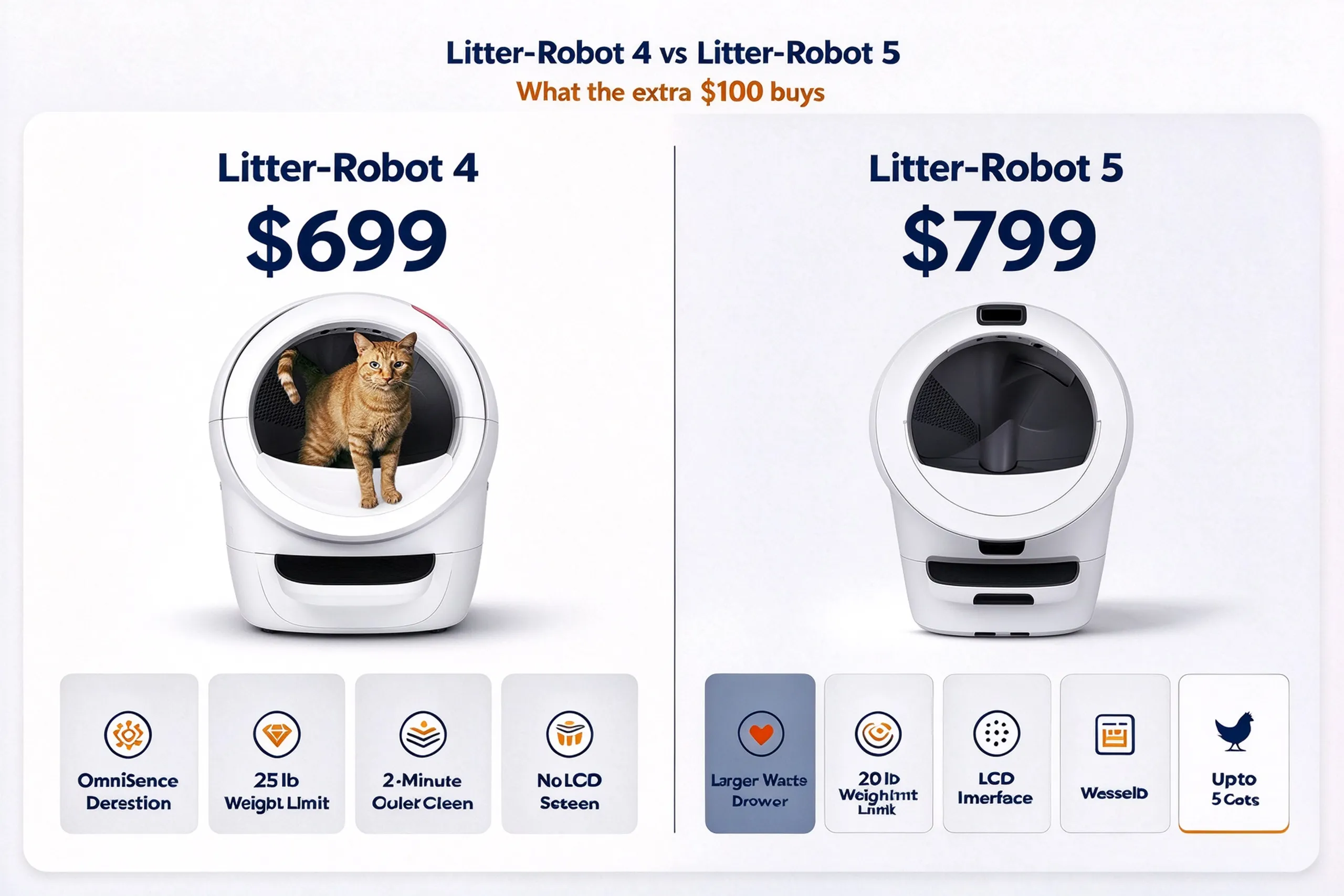
The purchase decision now includes an extra consideration: the Litter-Robot 5 at $799 ($100 above the LR4's $699 list price, with the LR5 Pro at $899). The LR5 adds a larger waste drawer, a 30-lb weight capacity, an LCD interface, WasteID, and support for up to five cats.
What LR4 Owners Consistently Report (community forums and owner reviews, 2024–2026):
“The mechanism is the whole reason this thing costs $699 instead of $200.”
Engineering Assessment: A rotating globe with a precision screen separating clean litter from waste is far more mechanically complex than conventional rake or belt units. Laser and weight sensors log cat entries, activating a 7-minute countdown before a 2-minute Clean cycle. This unhurried rotation ensures clumps drop into the waste drawer intact rather than crumbling into clean granules.
“Weight-sensor calibration is the second recurring gripe. The OmniSense sensors need recalibrating every time you move the box, every time the litter level changes much, and after any firmware update. Skip it and you get false 'cat in globe' errors that pause cycling, or cycles that fire with no cat present. Calibration takes two minutes. It’s the frequency that surprises people.”
The "Reset" Protocol: Whisker's documentation advises owners to press the Reset button (re-zeroing the scale) after any action that alters unit weight: emptying the waste drawer, topping up litter, cleaning, or shifting position.
“Do not buy LR4 while remaining emotionally committed to a litter it cannot sift properly. One of them will have to leave.”
Screen Limitations: The LR4 sifting grid is calibrated exclusively for standard-weight, rapid-clumping sodium bentonite clay litter. Lightweight clay escapes the screen; non-clumping litter fails to form separable waste; crystal/silica slips through; and plant/pellet litters jam the mechanism completely. Incompatible litter is the #1 cause of return remorse.
“The motor is quieter than the 3 and it isn’t silent, and the globe rotating at 3 a.m. will wake a light sleeper if the box is in the bedroom.”
Acoustic Reality: While the QuietSift motor is noticeably quieter than the LR3 (40–55 dBA vs. 60–62 dBA at 20 inches), it is not silent. In a dark room where late-night ambient baseline noise drops below 30 dB, the cleaning rotation is clearly audible. Light sleepers must prioritize setting the unit behind a closed door or away from sleeping quarters.
Litter-Robot 4 Specifications (2026)
All specifications below are sourced from Whisker’s official Litter-Robot 4 product page and official support documentation, verified against third-party review measurements where available. Running cost estimates are directional figures from current retail pricing and should be confirmed at time of purchase.
Specification | Value | Source / Notes |
Retail price (2026) | $699 (standard) │ $799 with 3-year extended warranty | Whisker official — confirm before purchase; bundle pricing varies |
Dimensions (W × D × H) | 22″ W × 27″ D × 29.5″ H (footprint 22″ × 27″); the optional LitterHopper accessory extends the footprint to 22″ × 28.8″ in total | Whisker official spec pages (LR4 and LR4 LitterHopper) |
Weight (empty) | 24 lbs | Whisker official |
Globe entry opening | 15.75″ wide | Whisker official — entryway 15.75″ × 15.75″; Whisker designs the LR4 for cats 3–25 lbs |
Interior headroom | 15″–17″ depending on litter level; interior roughly 19″ W × 18″ D | Whisker support FAQ — most domestic cats, including large breeds, fit comfortably in a natural elimination posture |
Cat weight range | 3 lbs minimum (sensor floor) │ Whisker states 3–25 lbs on product pages; its support FAQ says there is no weight limit | Whisker official (product page and comparison table vs support FAQ); 3-lb minimum is sensor detection floor, not a safety threshold |
Multi-cat capacity | Up to 4 cats | Whisker official (up to 4 cats). The 1-unit-for-1–2-cats / 2-units-for-3–4-cats split is AITAKON’s practical advice, not a Whisker specification |
Waste drawer capacity (single cat) | Up to 8 days between empties (1-cat household) | Whisker product page; real-world: 5–7 days at correct litter depth |
Cycle delay (configurable) | 3 to 30 minutes after cat exit — set in Whisker app | Whisker official; default is 7 minutes |
WiFi requirement | 2.4 GHz only — 5 GHz not supported | Whisker official; known friction point for households with 5 GHz-only routers |
Sensor system | OmniSense™: weight scale in the base + 3 curtain laser sensors in the bezel (plus anti-pinch sensors at the waste-drawer chute) | Whisker support documentation (sensors and functions; safety features) |
Odor system | OdorTrap™ system: sealed waste drawer + carbon filter (optional OdorTrap Packs) | Whisker official; carbon filter replacement recommended monthly, OdorTrap Packs every 2 weeks |
Noise level | Quieter than LR3 (QuietSift® motor) — not silent | Whisker markets QuietSift as near-silent; YourBestDigs measured 40–55 dBA at 20 in (LR3: 60–62 dBA); community reports: audible in a quiet room at 3–4 metres |
Power | 15V DC adapter into a standard outlet; no built-in battery — an optional rechargeable backup battery kit is available (24–48 hours of reserve power; not compatible with LitterHopper) | Whisker official |
App | Whisker app (iOS/Android); 7-day visit history free; extended history requires Whisker+ subscription | Whisker+ page (up to 2 years of activity history with Whisker+); the 7-day free window is per the PetTechai review (Jul 2026), not stated on Whisker’s page |
Odour consumables | Carbon filter: $12 per 2-pack / $30 per 6-pack → ~$60–72/year at monthly replacement. Optional OdorTrap Packs: $15 per 3-pack, replaced every 2 weeks → ~$110–130/year | Whisker official list pricing, verified October 2026; promotions are common |
Waste bag cost | Whisker custom-fit liners: $25 per 25-pack │ Standard 8-gallon kitchen bags: cheaper alternative | Whisker official list pricing; standard-bag compatibility is community-reported (Whisker says custom-fit liners support more accurate waste-level readings) |
Warranty | 1-year standard │ 3-year extended ($100 additional) | Whisker official |
How the Mechanism Works — and Why It's Designed That Way
The Litter-Robot 4’s mechanism has remained fundamentally the same across all four generations: a rotating globe that sifts clean litter from waste clumps and deposits the waste into a sealed drawer below. The LR4 iteration adds the OmniSense detection system, a quieter motor, and the OdorTrap odour containment system. Understanding what the mechanism does and why it’s designed as it is explains both the performance ceiling and the failure modes.
Globe Rotation: Why Speed Is a Design Decision, Not a Limitation
The LR4’s Clean cycle takes about 2 minutes (Whisker’s LR4 manual). In our engineering assessment, the unhurried rotation is a deliberate design choice: faster rotation would shorten the cycle but risk fragmenting clumps before they reach the screen, distributing urine-soaked litter back into the clean bed rather than depositing intact clumps into the waste drawer. Slow rotation helps preserve clump integrity so that the separation is clean — which is why litter compatibility is so specific: only fast-clumping, standard-weight sodium bentonite litter forms clumps firm enough to survive the rotation intact. Litters that form soft or crumbling clumps don’t survive the rotation cleanly regardless of mechanism speed.
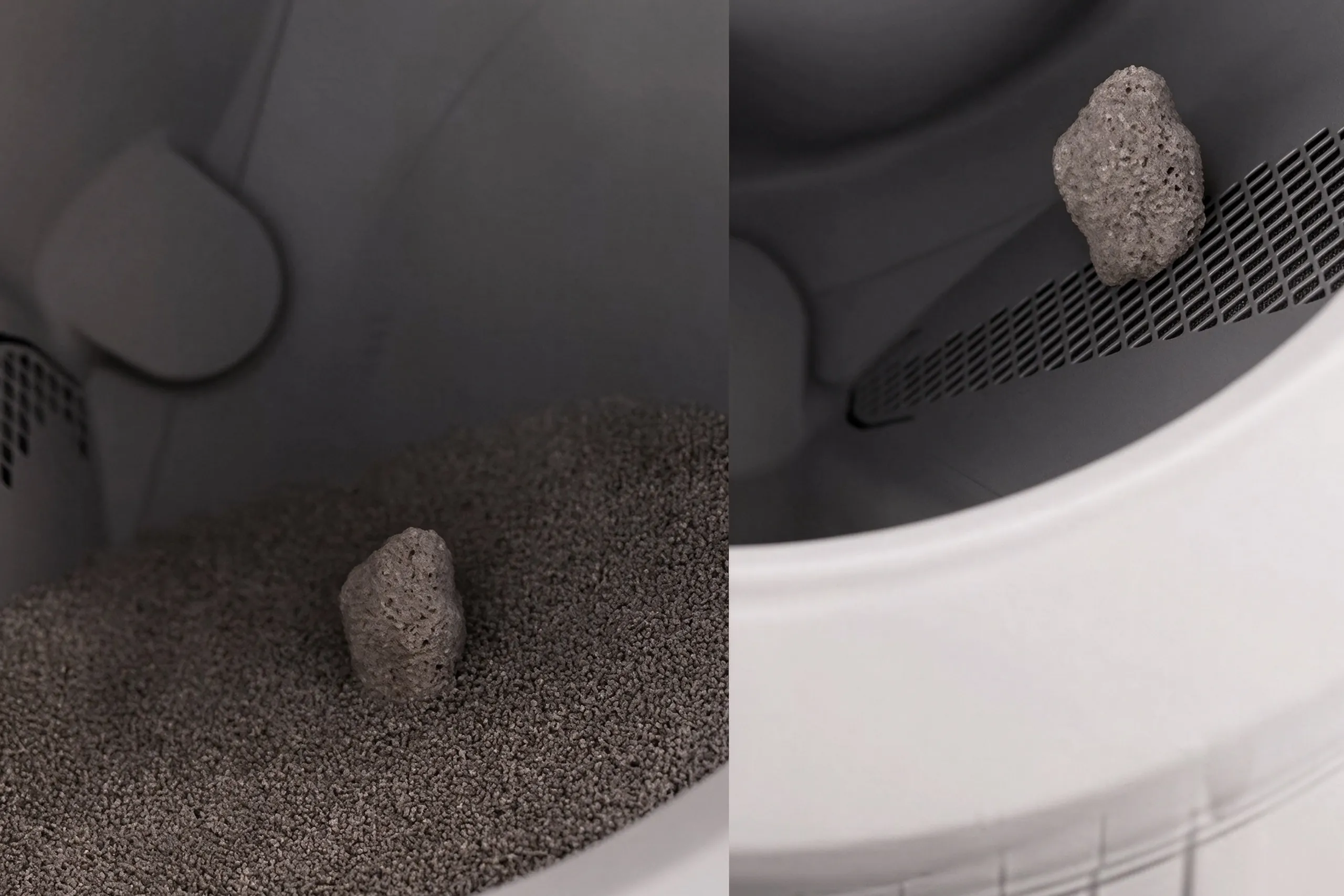
The screen inside the globe is the separation mechanism — clean litter granules fall through the screen during rotation, and intact clumps (too large to pass through) ride over the screen and drop into the waste drawer below. This is why the screen mesh size is a critical manufacturing parameter: too fine and clean litter can’t fall through; too coarse and small clumps pass through into the clean litter. Whisker does not publish its screen aperture, but the mechanism is evidently matched to standard sodium bentonite clumping litter, which Whisker names as the best-performing type. Lightweight litters with smaller grain size pass through the screen into the waste drawer; pellet and non-clumping litters produce no separable clumps at all.
OmniSense Detection: What the Weight Scale and Three Laser Sensors Actually Do
The OmniSense system — documented in Whisker’s official sensor documentation — combines two distinct detection technologies. Three curtain laser sensors in the bezel look downward across the globe opening and detect when a cat enters or exits; a weight scale in the base further detects and weighs the cat, and tracks individual cat weights over time for health monitoring. Whisker states that the laser and weight sensors together detect when your cat enters and exits the globe, which triggers the countdown timer and cleaning cycle.
The redundancy is the safety feature — and what Whisker documents is the halt. During a cycle, either sensor type can stop the globe: if a cat attempts to enter, the curtain sensors halt it (the light bar turns red), and if additional weight is detected, the weight scale stops it. Whisker adds anti-pinch sensors on both sides of the waste-drawer chute and a SafeCat system that continuously analyses four safety zones. The cycle does not resume until 15 seconds after the cat is no longer detected. Whisker does not publish how the two sensor types combine to start a cycle, so we describe only what is documented. This separates the LR4 from budget automatic boxes where a single sensor failure defaults to active (cycle begins regardless), and it matches the ‘immediate halt’ safety standard discussed in our guide to whether self-cleaning litter boxes are safe.
The upkeep is the tradeoff for this sensor accuracy. Whisker documents three routines: press the Reset button, which re-zeros the weight scale, after anything that changes the unit’s weight (emptying the drawer, adding or removing litter, cleaning or moving the unit); keep the curtain sensors clean, since they auto-calibrate their detection levels and flag a fault when they are dirty; and, if the waste gauge reads wrong after emptying, follow Whisker’s drawer-level calibration guide (it uses a recalibration card or plain white paper and requires current firmware). Skipping these routines produces the false ‘cat in globe’ errors and inaccurate litter and waste readings that owners and reviewers describe.
Reset, Clean, Calibrate: The OmniSense Habits Whisker Documents
Whisker's official engineering guidance outlines four operational triggers where hardware recalibration is required. Routine resets correct baseline drift, but do not replace periodic physical sensor cleaning.
Press the Reset button on the control panel (takes 1 second). Ensure nothing is resting or leaning on the unit while re-zeroing the scale.
Direct signal that the bezel sensors require cleaning. Accumulated dust or cat fur is impeding the curtain lasers.
Occurs when the waste gauge stays desynced after emptying. Run the Drawer Full Indicator (DFI) calibration following Whisker's guided sequence.
Simultaneously hold Cycle + Reset + Empty for 3 seconds. The unit executes an automatic Clean cycle and recalibrates the level baseline.
The three optical curtain sensors positioned inside the upper bezel naturally attract litter dust and airborne fur over time, causing false pause cycles. Whisker recommends the following cleaning steps:
- Surface wipe: Wipe the bezel face with a clean, dry microfiber cloth.
- Perimeter vacuum: Gently vacuum the inside rim using a soft brush attachment (or apply gentle blasts of compressed air).
- Detail stubborn spots: Use a dry cotton swab to lift remaining debris from the sensor recesses.
- Run diagnostic cycle: Short-press Reset, then short-press Cycle to verify detection accuracy.
Odour Control: What the OdorTrap System Does and Doesn't Do
The LR4’s OdorTrap system — a sealed waste drawer with a carbon filter — is among the better odour containment systems in the consumer automatic litter box category. As our litter box odor control guide explains, the sealed drawer addresses the primary odour problem (waste sitting exposed in the litter bed) by removing waste within minutes of each use. Understanding the OdorTrap’s limits prevents the most common post-purchase disappointment with the unit.
What the OdorTrap System Controls — And the Drawer Burst Problem
The sealed waste drawer with carbon filter typically keeps ambient room odour lower than a manual litter box or non-sealed automatic unit. The mechanism is correct: waste is removed from the litter bed quickly, sealed behind a tight-fitting drawer door, and the carbon filter adsorbs ammonia that escapes through the seal. In a typical one-cat household, the room around the LR4 smells noticeably better than the equivalent manual box maintained on a twice-daily scooping schedule.
The OdorTrap’s limit is concentration over time. Every cleaning cycle deposits one or more clumps into the sealed drawer. Over several days, the ammonia concentration inside the drawer increases as the waste accumulates. When the drawer is opened for emptying — a weekly task for most single-cat owners, more frequent for multiple cats — the concentrated ammonia releases in a burst. This is not a product defect; it is the design tradeoff of sealed containment. The drawer smells significantly more intense than waste in an open traditional box would, because the odour has been concentrated rather than diffusing gradually. The burst is brief and manageable with the drawer opened in a ventilated area.
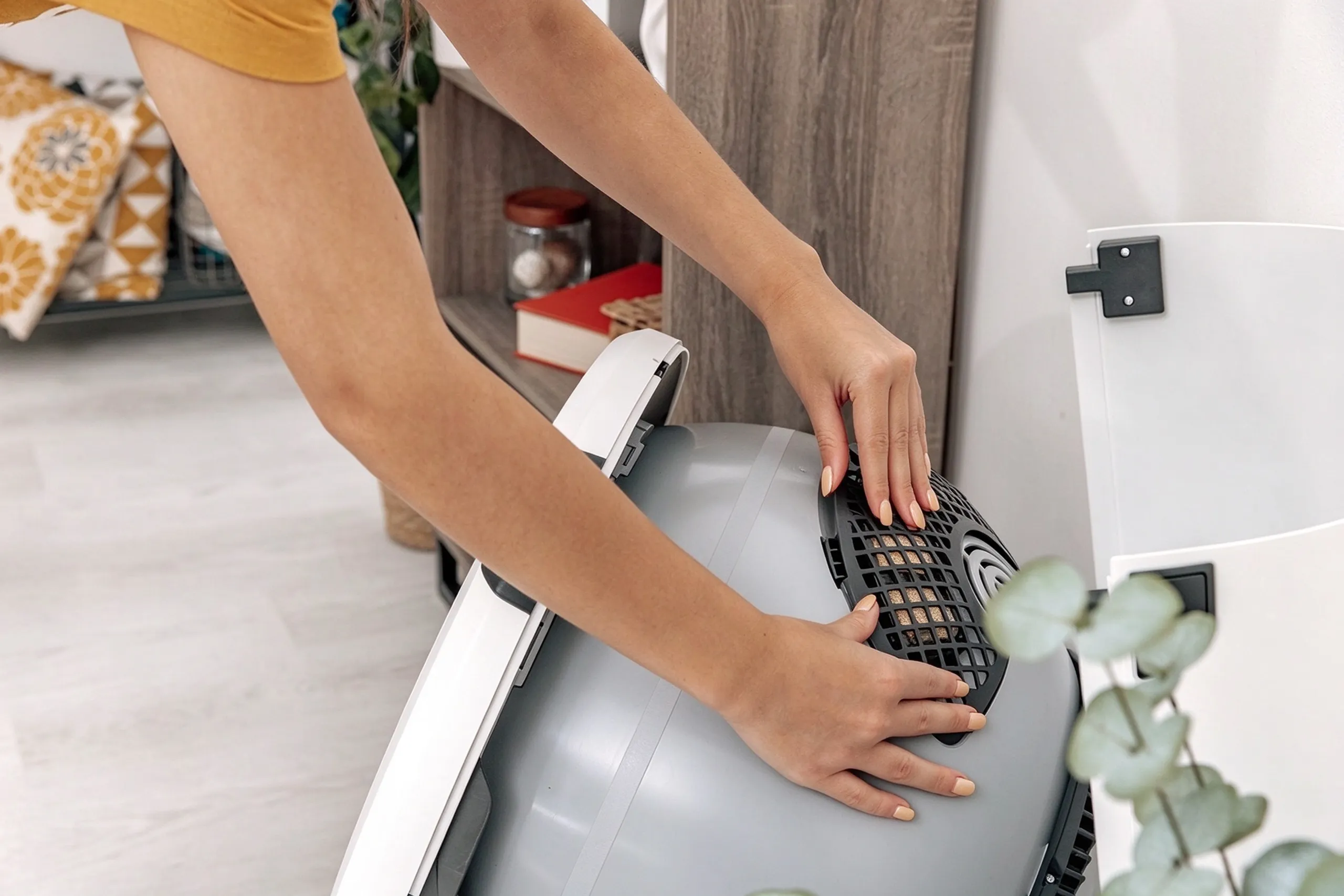
The carbon filter is the part Whisker recommends replacing monthly (the interval is ultimately up to you and your cats’ usage), and the optional OdorTrap Packs every two weeks; heavy use or warm environments can shorten both. A saturated filter provides little adsorption benefit while the sealed drawer keeps concentrating odour — meaning room odour gradually returns as the filter saturates. Replacing the filter on a consistent monthly schedule (rather than waiting until the smell returns) maintains the OdorTrap system’s performance continuously.
Litter Compatibility: The Non-Negotiable Constraint
Litter compatibility is the LR4 specification that matters most for day-to-day performance and is the most commonly overlooked before purchase. The sifting mechanism is optimised for one litter type. Deviating from it degrades performance in specific, predictable ways.
| Litter Type | LR4 Compatibility | Failure Mode If Used | Recommendation |
|---|---|---|---|
| Standard sodium bentonite clumping clay e.g., Dr. Elsey's Precious Cat, Arm & Hammer Clump & Seal | ✅ Optimal | None — designed specifically for this density and grain size. | The correct litter for LR4. Fast-clumping, standard grain size, and adequate weight to trigger OmniSense sensors reliably. |
| Lightweight clumping clay | ⚠️ Problematic | Lighter granules escape through the screen into the waste drawer; inaccurate litter-level sensor readings due to reduced weight-per-volume. | Avoid. Causes inconsistent performance. Always stick to standard-weight clay. |
| Silica crystal / silica gel | ❌ Not recommended | Non-clumping crystals form no mass for sifting; translucent/white crystal litter impairs optical litter-level and drawer sensors (Whisker). | Not recommended by Whisker. Standard clumping clay remains necessary for reliable operation. |
| Tofu / plant-based clumping | ⚠️ Variable | Softer clumps crumble during globe rotation; reliability depends heavily on brand density and binder firmness. | Test with caution. Some brands sift adequately, while others break apart. PetTechai (Jul 2026) notes high brand-to-brand variance. |
| Wood pellets / paper pellets | ❌ Incompatible | Pellets do not form clumps; rotation mechanism cannot separate soiled material from clean substrate. | Do not use. Incompatible with sifting grate dimensions. |
| Non-clumping clay | ❌ Incompatible | No clump formation; urine-soaked granules redistribute evenly throughout the clean litter bed during cycling. | Do not use. Quickly ruins clean litter and leads to severe odor buildup. |
Looking for the tested winners? For a full analysis of which specific brands perform best — including clumping firmness tests and sensor accuracy ratings — read our in-depth review.
Best Litter for Automatic Litter Box GuideReal-World Performance: What Owners Actually Report
Synthesised from community forums (Reddit r/litterrobot), verified Amazon reviews, and independent reviews published in 2025–2026. This is the performance picture after the first month — after the novelty has worn off and the real operational patterns have emerged.
Where the LR4 Consistently Performs Well
Cleaning reliability is the LR4’s strongest real-world attribute. Owners running the unit correctly — sensors kept clean and reset as needed, appropriate litter, correct depth, drawer emptied on schedule — report consistent, error-free cycling across months and years of use. The mechanism does not degrade meaningfully over time in the way that rake-style units do, where the rake track accumulates residue that eventually affects cleaning quality. The globe’s smooth interior is easier to clean thoroughly, and the rotation mechanism has fewer contact points that wear.
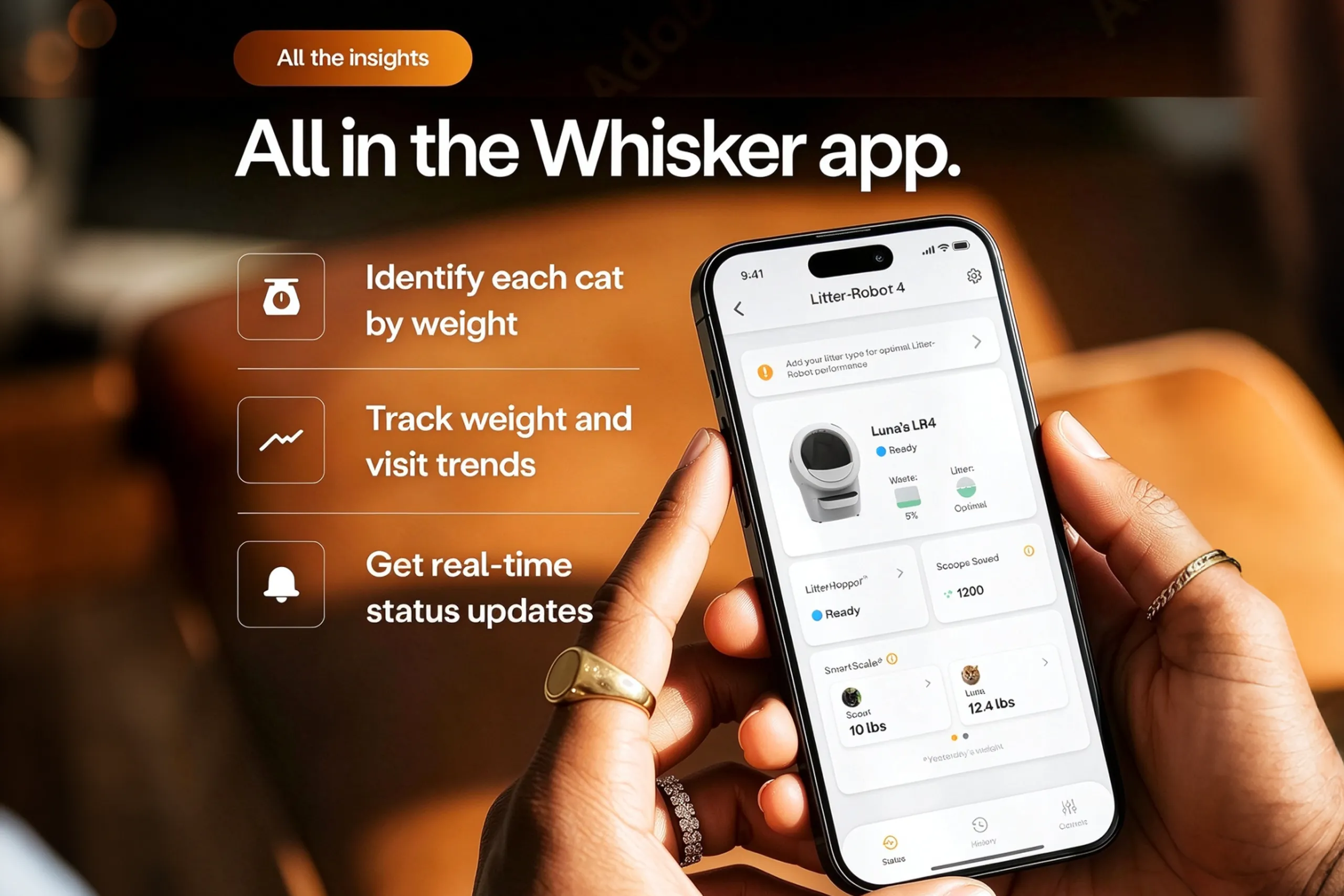
Health monitoring through the Whisker app is the secondary feature that converts many owners from ‘automatic box buyer’ to ‘long-term Whisker ecosystem user.’ Visit frequency, duration, and individual cat weight tracking over time can reveal changes — often associated with urinary tract problems, kidney disease or diabetes — that are worth raising with your veterinarian. The app is a monitoring aid, not a diagnostic tool; a manual box cannot provide this data at all, particularly in a multi-cat household where attributing changes to a specific cat is otherwise impossible. This is covered in depth in our guide to self-cleaning litter boxes for multiple cats.
Known Issues That Appear Consistently in Owner Reports
WiFi connectivity is the most frequently cited operational frustration. The LR4 supports 2.4 GHz WiFi only. Modern routers that use a merged 2.4/5 GHz SSID sometimes assign the LR4 to the 5 GHz band, which the unit cannot use. The symptom is repeated WiFi disconnection without obvious cause. The fix is creating a dedicated 2.4 GHz SSID on the router or using a WiFi extender configured to 2.4 GHz near the unit. This is a setup issue, not a hardware defect — but it requires router access and some technical comfort to resolve.
Sensor errors are the second pattern. As described above, Whisker’s documentation calls for pressing Reset after anything that changes the unit’s weight — emptying the drawer, adding or removing litter, cleaning or moving it — and for keeping the bezel sensors clean. Owners who skip these steps report false ‘cat in globe’ errors and inaccurate litter and waste readings, the same pattern the reviewer quoted above describes. Making Reset-after-emptying a habit addresses the ++++++usual cause.
Mid-cycle stops occur when a curtain sensor detects motion during rotation — which can be triggered by vigorous litter movement inside the globe during the cycle, not only by a cat. Fine, dusty litter disperses during rotation and can momentarily interrupt the laser beam, causing the globe to pause. Reducing litter dust (using a lower-dust litter brand or reducing litter depth slightly) addresses this. Our automatic litter box troubleshooting guide covers the full diagnostic sequence for mid-cycle stop errors.
Running Costs: The Full Annual Picture
The LR4’s $699 purchase price is the smaller part of its lifetime cost for most owners. The running costs — carbon filters, waste drawer liners, litter — accumulate significantly over the unit’s lifespan and should be factored into the purchase decision.
Item | Frequency | Annual Cost (1 cat) | Notes |
Carbon filters (OdorTrap system) | Monthly replacement | ~$60–72/year | Whisker official list: $12 per 2-pack or $30 per 6-pack (promotions are common). Optional OdorTrap Packs (replaced every 2 weeks; $15 per 3-pack) would add roughly $110–130/year |
Waste drawer liners / bags | Weekly (1 cat) to every 3 days (4 cats) | ~$50–75/year (official liners) | Whisker custom-fit liners: $25 per 25-pack (~$1 each). Standard 8-gallon kitchen bags cost less, but Whisker says custom-fit liners support more accurate waste-level readings |
Clumping litter | ~8–10 lbs/month (1 cat) | ~$80–150/year depending on brand | Same or slightly less than a manual box — clump-only removal wastes less litter than full bed replacement |
Whisker+ subscription (optional) | Annual | $79.90/year ($7.99/month) | Unlocks up to 2 years of cat activity history and extended insights; the free app covers standard insights. Optional — core function works without it |
Deep clean supplies (enzyme cleaner) | Monthly | ~$15–20/year | Enzyme cleaner for inner globe and base; same product used for all litter box surfaces |
Total annual running cost (1 cat, no Whisker+) | — | ~$205–320/year | Varies by litter brand choice and drawer-bag source |
Total annual running cost (1 cat, with Whisker+) | — | ~$285–400/year | Whisker+ adds meaningful value for multi-cat health monitoring; marginal for single healthy cat |
LR4 vs LR5 in 2026: Which to Buy
The Litter-Robot 5 launched in October 2025 and changes the LR4 purchase calculus in 2026. The LR5 is not a minor iteration — it introduces meaningful hardware upgrades, at a $100 higher list price ($799; the LR5 Pro is $899). Buyers considering the LR4 in 2026 should evaluate both before purchasing.
Feature | Litter-Robot 4 | Litter-Robot 5 |
Price (2026) | $699 | $799 ($100 above the LR4; LR5 Pro $899) |
Cat weight limit | 3–25 lbs (Whisker’s stated range) | 3–30 lbs (stated) |
Multi-cat support | Up to 4 cats | Up to 5 cats |
Waste drawer capacity | Standard | Larger — longer intervals between empties |
WasteID feature | Not available | Available — distinguishes urine from faeces events separately |
Interface | 5-button control panel + LED | LCD touchscreen interface |
Sensor system | OmniSense (weight scale + 3 laser) | Updated OmniSense generation |
When LR4 makes sense | 1–4 cats under ~25 lbs, when the $100 saving matters more than WasteID or extra capacity | Five cats, cats over 25 lbs, or you want WasteID, the larger drawer and the LCD interface — worth the $100 premium |
Whisker discontinued the Litter-Robot 3 and 3 Connect. The LR4 remains in production and supported as of October 2026, listed from $699 against $799 for the LR5. For one to four cats under 25 lbs, the $100 saving makes the LR4 the better value unless you specifically want the LR5’s extra capabilities. Retail promotions and bundles vary and can narrow the gap, so compare current prices.
Who Should (and Shouldn't) Buy the Litter-Robot 4
Who the LR4 Is Right For
The LR4 is well matched for: owners with 1–2 cats who want to replace a scooping schedule with a drawer-emptying schedule; households where ambient odour control matters more than purchase cost; multi-cat homes where individual health monitoring via the app adds real value; and buyers who are prepared to use correct clumping litter and follow a basic reset-and-cleaning routine. For the complete evaluation framework across the full self-cleaning litter box category, see our best self-cleaning litter box guide.
The safety architecture — independent laser and weight detection, immediate halt on mid-cycle detection, anti-pinch sensors at the waste-drawer chute, and Whisker’s SafeCat monitoring — makes the LR4 one of the safer automatic litter box designs in the consumer category. Our guide to are self-cleaning litter boxes safe covers the specific design properties that determine safety outcomes across the category, and the LR4 meets the primary safety criteria.
Who the LR4 Is Not Right For
The LR4 is a poor fit for: owners with kittens under 3 lbs (below sensor detection floor — use in semi-automatic mode only); owners who use crystal, silica, pellet, or non-clumping litter and are unwilling to switch; households where the litter box must be in a bedroom and light sleepers will be disturbed by the roughly 2-minute cycle at night; owners who want set-and-forget operation without any maintenance schedule; and buyers who need the LR5’s extra capabilities — five cats, cats over 25 lbs, or WasteID — and are willing to pay the $100 premium.
Frequently Asked Questions
The Litter-Robot 4 measures 22 inches wide × 27 inches deep × 29.5 inches tall and weighs 24 lbs empty; the optional LitterHopper accessory extends the footprint to 22 × 28.8 inches. The globe entryway is 15.75 inches wide and 15.75 inches high — wide enough for large breed cats including Maine Coons. Whisker lists the interior of the globe at roughly 15–17 inches high (depending on litter level), 19 inches wide and 18 inches deep, which accommodates large cats in a natural elimination posture without hunching. Before purchasing, confirm that the placement location has adequate floor space for the full footprint plus approach space for the cat, and that there is no overhead obstruction above the globe height.
Whisker's product pages and comparison tables state that the Litter-Robot 4 is designed for cats from 3 to 25 lbs, while its support FAQ says the unit has no weight limit; many owners report successful use with cats over 25 lbs. The 3-lb minimum is a sensor detection floor, not a safety threshold — cats under 3 lbs are too light to reliably trigger the OmniSense weight sensors, which means the cleaning cycle may activate while an underweight kitten is still inside. Whisker's guidance for kittens under 3 lbs is to operate in semi-automatic mode: keep the unit powered off, manually power on after observing the kitten use the box, let the cycle complete, then power off again. Continue this supervised mode until the kitten reaches 3 lbs.
Standard-weight, fast-clumping sodium bentonite clay litter is the correct litter type for the LR4. Commonly cited brands that perform well include Dr. Elsey's Precious Cat Ultra and Arm & Hammer Clump & Seal. The litter must form firm, dry clumps that hold together through the roughly 2-minute globe rotation — soft or crumbling clumps distribute residue into the clean litter bed. Litter depth should be maintained at 3–4 inches inside the globe; lower depth causes urine to pool at the globe floor before clumping. Whisker advises against non-clumping, loose-clumping, newspaper and wood or paper pellet litters (they do not work) and translucent or white crystal litter (it can impair level sensing), notes that plant-based litters typically do not filter properly, and recommends standard-weight clay, so lightweight clumping clays are a poor match. See our best litter for automatic litter boxes guide for a full compatibility analysis.
For a single cat in normal health, the waste drawer requires emptying approximately once per week — Whisker states up to 8 days for a 1-cat household. In practice, 5–7 days is more realistic at correct litter depth and normal waste volume. For two cats, every 3–5 days. For three to four cats, every 2–3 days. The Whisker app sends a notification when the drawer-full indicator (DFI) laser sensor detects the drawer at capacity, but waiting for this notification allows the drawer to reach the odour-escape threshold before the alert fires. Emptying 1–2 days before the alert in small spaces — apartments, low-ventilation rooms — produces better ambient odour outcomes.
Mid-cycle stops have three common causes: a curtain laser sensor detecting motion inside the globe during rotation (the most common — triggered by litter dust dispersing and interrupting the laser beam), a cat re-entering the globe during the cycle, or dirty sensors producing false detections. For litter dust interference: switch to a lower-dust litter or reduce litter depth slightly. For recurrent false detections with no cat present: clean the curtain sensors in the bezel — wipe with a dry cloth, vacuum the inside perimeter with a brush attachment, then run a test cycle (short press Reset, then Cycle) — and press Reset after any change to the unit's weight, such as emptying the drawer, adding litter or moving the unit. If the light bar shows green with partial red flashing, Whisker's documentation says the sensors need cleaning. Dust and fur on the sensor lenses are a common hardware cause. Our automatic litter box troubleshooting guide covers the full diagnostic sequence.




