

USDA food safety danger zone guidelines • PetMD wet food storage guidelines • Cats.com independent 13-feeder test (2026) • autopetfeed.com 60-day Cat Mate C500 wet food trial • hometosight.com semiconductor cooling analysis (May 2026) • Petlibro Polar official documentation (2026) • AITAKON OEM wet food feeder engineering assessment
Quick Answer
What is the best automatic cat feeder for wet food?
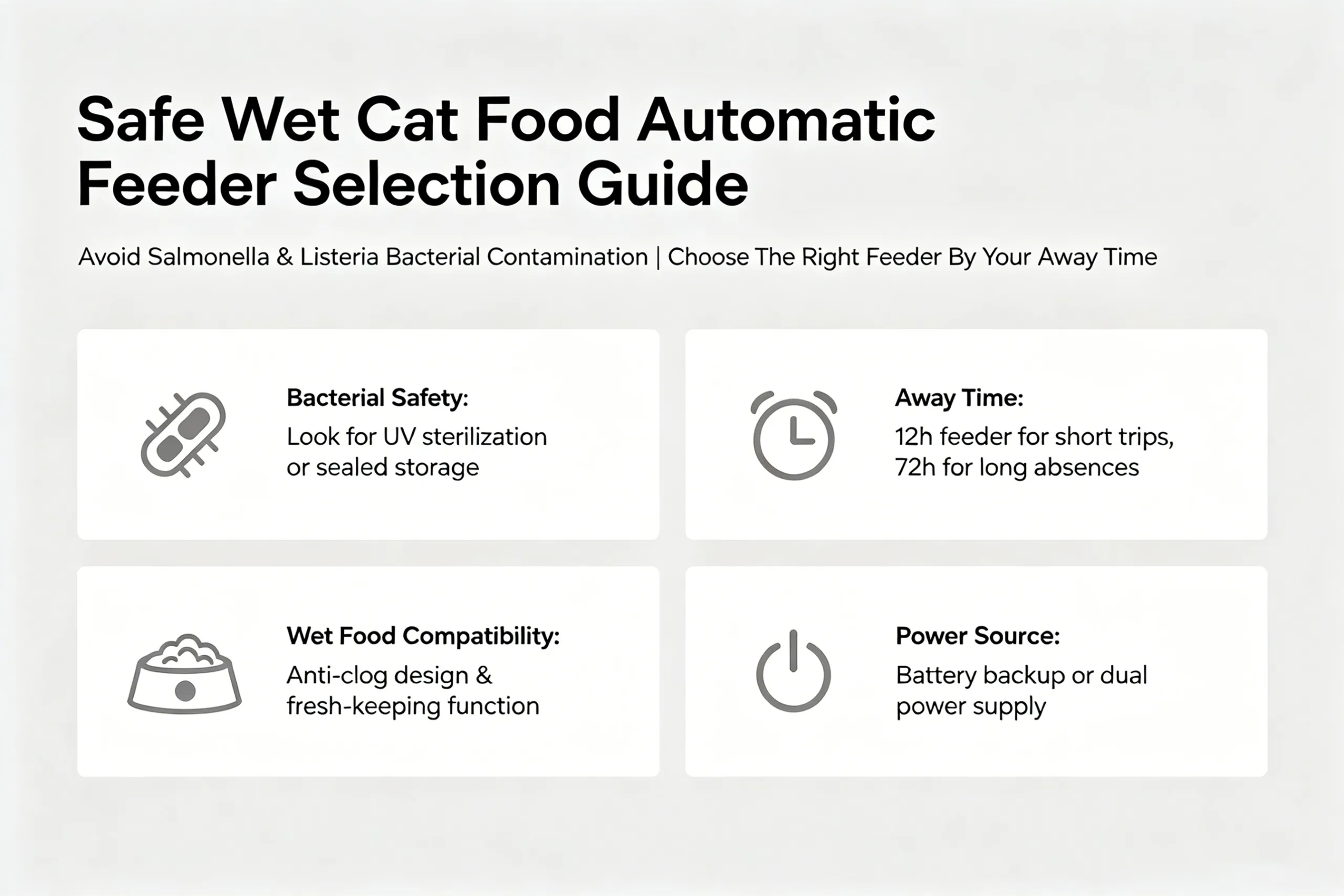
There is no single best model — the right choice depends on how long you need the food to stay safe. Wet food left at room temperature enters the bacterial danger zone (above 40°F) immediately after serving. USDA guidelines classify this range as the window where Salmonella and Listeria multiply most aggressively.
-
Absences up to 8–12 hours
A tray-rotation feeder with ice packs (Cat Mate C500, Casfuy). Simple mechanics, no power dependency, proven reliability over decades.
-
Absences of 1–3 days
A semiconductor-refrigerated feeder (Petlibro Polar, UBPET). Active cooling maintains 35–45°F continuously. Requires AC power — the cooling circuit has no battery fallback.
-
The Majority: Standard 8–10 hour workdays
An ice pack feeder used correctly (packs frozen solid overnight, ambient room temperature below 78°F) is the more reliable choice — lower cost, simpler mechanics, no firmware updates, no cooling failure modes.
Most automatic cat feeders — gravity dispensers, hopper-auger units, all standard dry food dispensers, automatic canned cat food feeders that use auger mechanisms — cannot be used for wet food safely. Wet food clogs auger mechanisms, spoils without cooling, and creates bacterial biofilm in hoppers within hours. The wet food feeder category is a separate product entirely.
What Owners and Independent Testers Report (2025–2026):
"Dry food lasts days. Wet food? 2 hours safe, 4 hours risky, 6 hours dangerous. I learned this at 3am with a vomiting cat."
"The C500 opening was on schedule 98% of the time over 60 days. The one missed meal was a low-battery issue."
"Since most cats prefer to eat wet food at room temperature, upcoming meals are kept in a non-refrigerated section 30 minutes before serving."
"The motor shorted on and continuously rotated the food dish."
The Problem Nobody Explains Clearly Enough
Walk into any pet store or scroll any review site and you’ll see automatic cat feeders marketed for both wet and dry food. Some will even show canned food photos. What most listings don’t tell you is that the dominant feeder architecture — the hopper-and-auger design used by Petlibro, PetSafe, and most mid-range brands — physically cannot handle wet food safely. The same applies to most automatic canned cat food feeders that use auger mechanisms: the design is fundamentally incompatible with high-moisture food, regardless of what the packaging claims.
Wet cat food is 70–80% moisture, high in protein and fat. At room temperature (70–80°F), bacteria double roughly every 20 minutes. By hour 4 you have meaningful bacterial load. By hour 6 the food is visibly degrading. By hour 8 in a warm home, you’re feeding your cat a genuine health risk.
The 4-hour rule gets quoted often. The more honest number is 2 hours — that’s the USDA food safety guideline for high-moisture protein food in the danger zone above 40°F. In homes above 80°F in summer, it’s closer to 60 minutes.
Feeder Types That Cannot Be Used for Wet Food
- Gravity dispensers: wet food clogs the hopper opening immediately. The food is also fully exposed from the moment it’s loaded — zero spoilage protection.
- Hopper-auger dry food feeders (Petlibro Granary, PetSafe Simply Feed, etc.): wet food jams the vane assembly, creates bacterial biofilm inside the hopper, and generates mold inside a sealed housing that’s invisible from outside. This includes most automatic canned cat food feeders marketed for multi-food use — the auger architecture cannot handle wet food safely regardless of what the listing claims.
- Conveyor-belt feeders: same contamination and spoilage issues as auger systems. Not designed for wet food regardless of what the product listing may suggest.
The Two Cooling Architectures: What They Actually Do
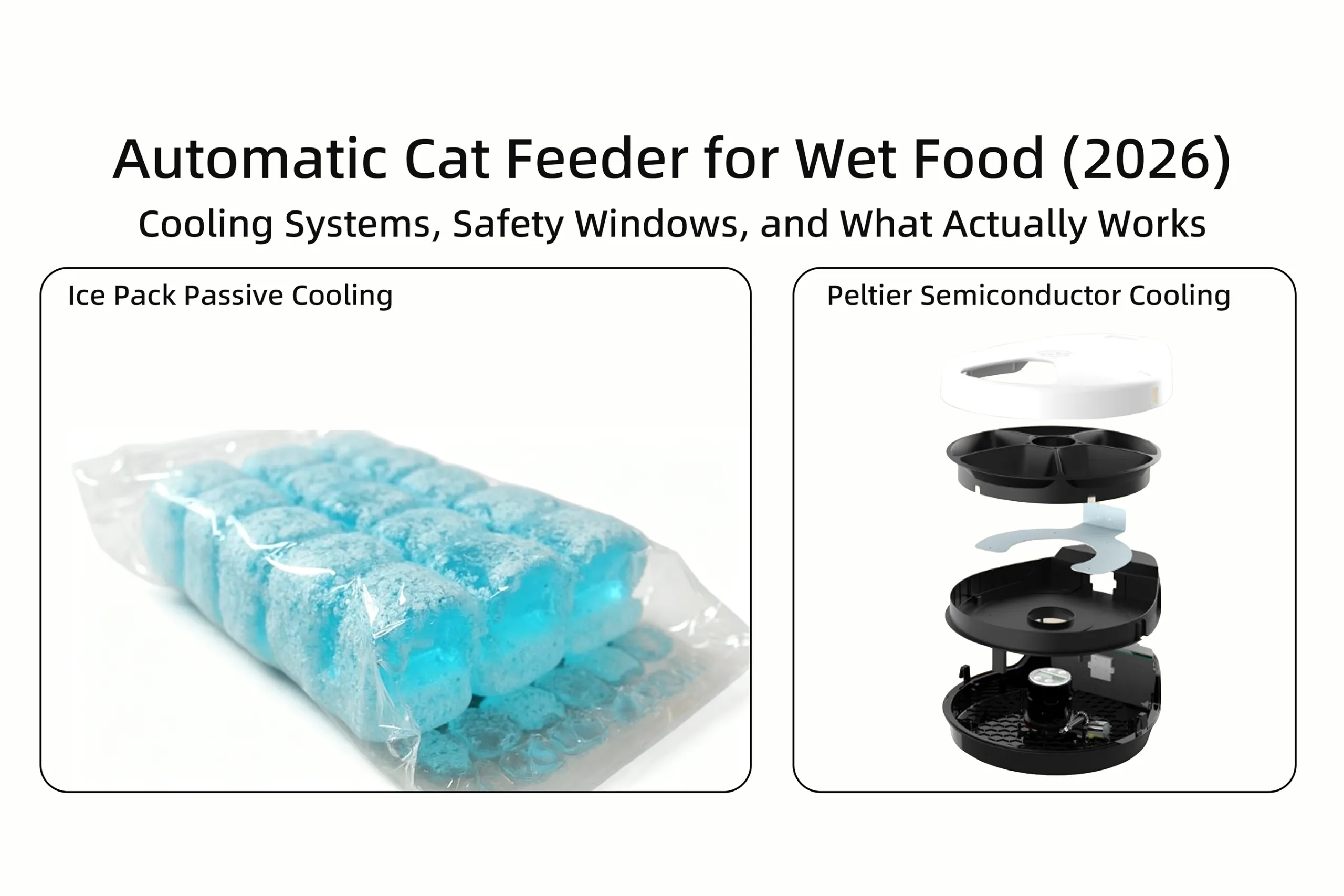
Every wet food feeder on the market uses one of two approaches to manage spoilage. Understanding the engineering difference matters more than any individual product comparison.
Ice Pack (Passive Cooling)
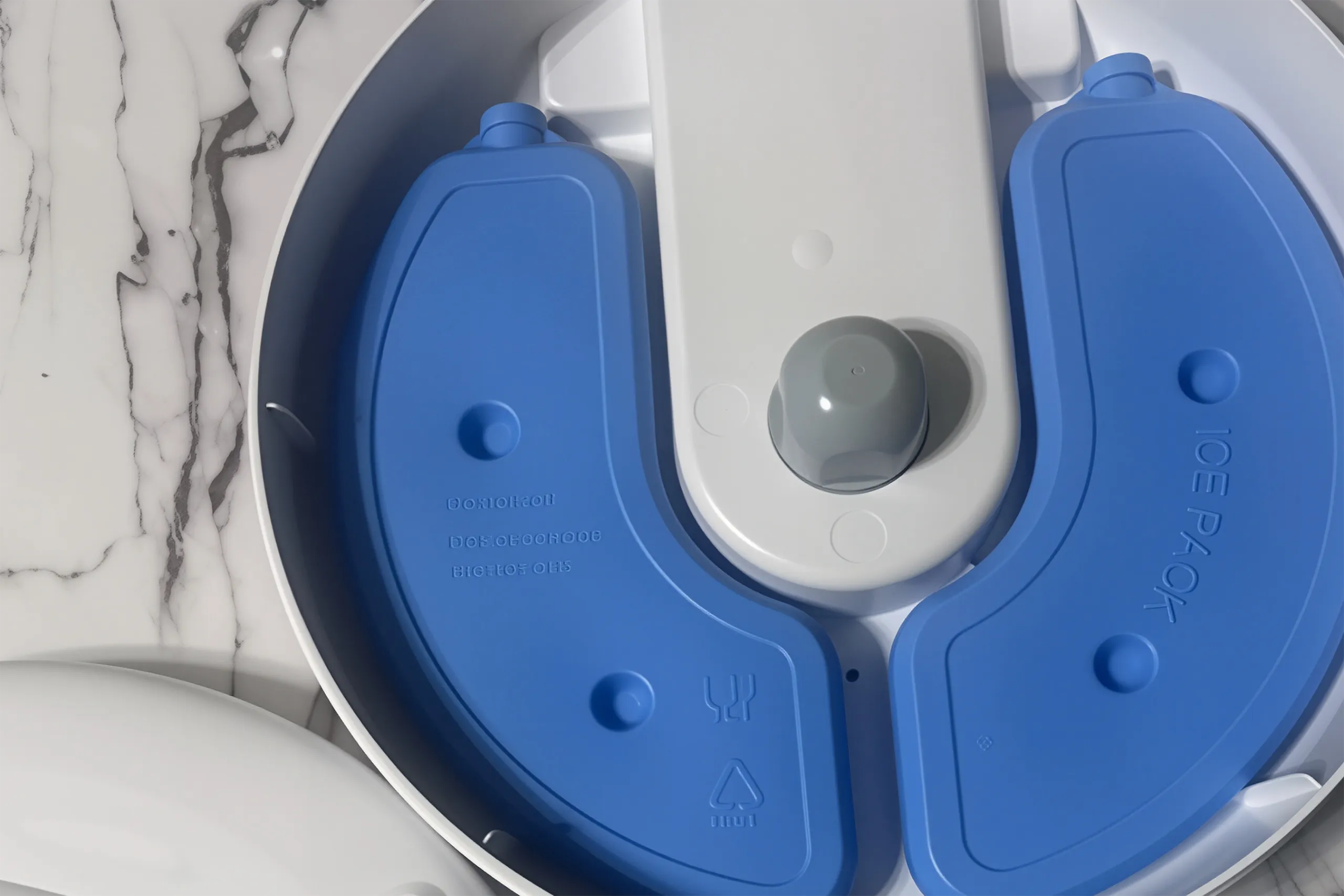
Frozen gel packs are placed beneath or around the food tray. They work by thermal mass — the frozen pack absorbs heat from the surrounding environment and from the food itself, keeping tray temperature below the danger zone for a finite period.
The effective cooling window is 6–12 hours under normal conditions (ambient room temperature 68–75°F, packs frozen solid overnight). In rooms above 78°F, that window compresses significantly — some independent tests report 4–6 hours in warm conditions. Below 65°F, packs can extend to 12+ hours.
The key variable is pack freeze state. A pack that was “quick frozen” for 2 hours gives you meaningfully less cooling than one frozen solid overnight. This is the most common reason ice pack feeders underperform in real-world use — not a design flaw, but a prep failure.
Ice Pack Performance: The Variables That Actually Matter
- Ambient room temperature: the single biggest factor. At 68°F the pack lasts 10–12 hours. At 78°F expect 6–8 hours. Above 82°F, 4–6 hours at best.
- Freeze duration: 8+ hours frozen solid (overnight) vs. a 2-hour “quick freeze” makes a 30–40% difference in cooling window, based on independent test observations. This single prep variable explains most reported ice pack underperformance — it’s not a design flaw.
- Pack size relative to food volume: smaller packs (some budget feeders) have less thermal mass and deplete faster than the larger gel packs designed for 5-tray feeders like the Cat Mate C500.
- Lid seal quality: an open-top tray warms significantly faster than one with a fitted cover. Always confirm whether the feeder lid seals against ambient air during the cooling period before the scheduled serving time.
Semiconductor (Peltier) Refrigeration
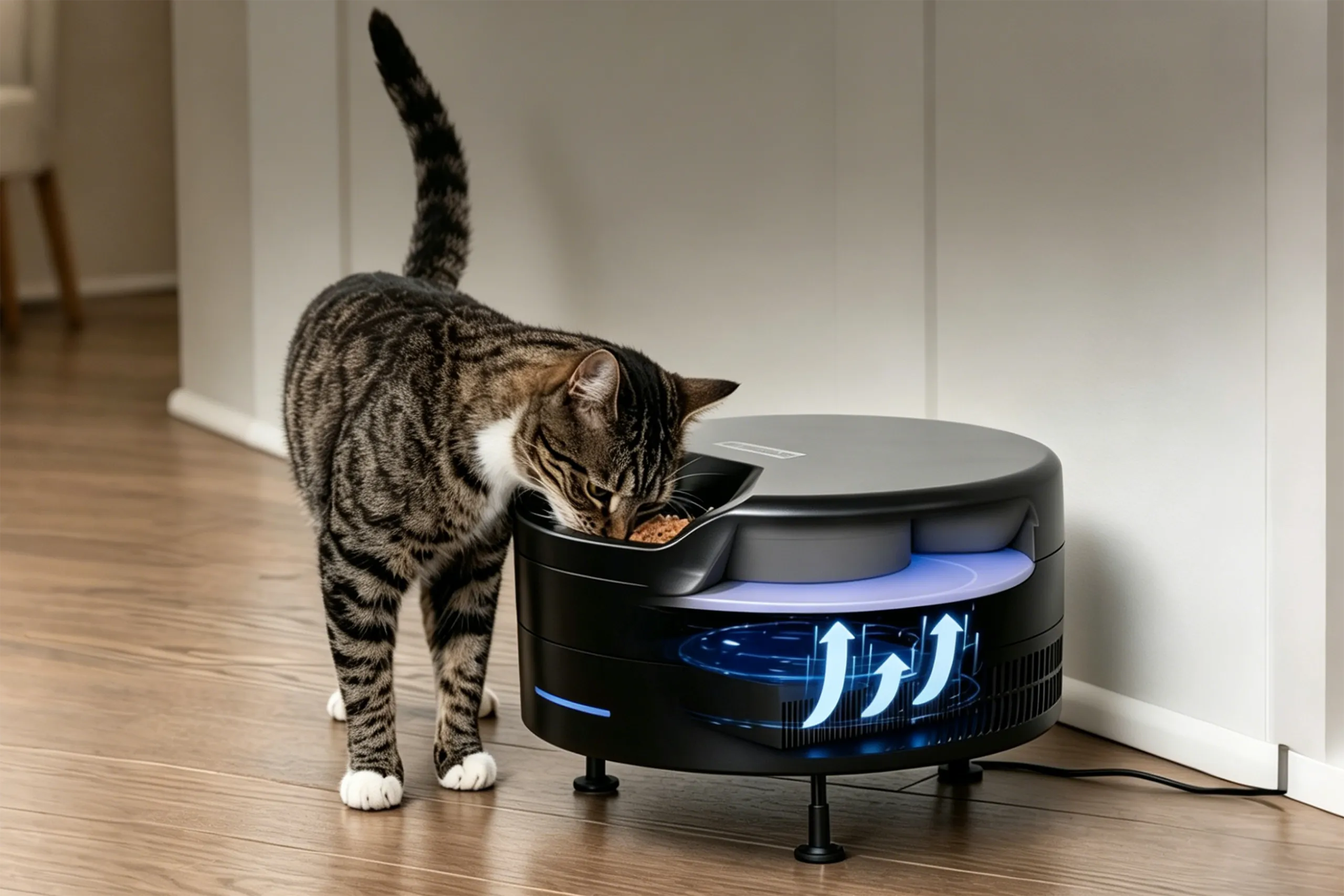
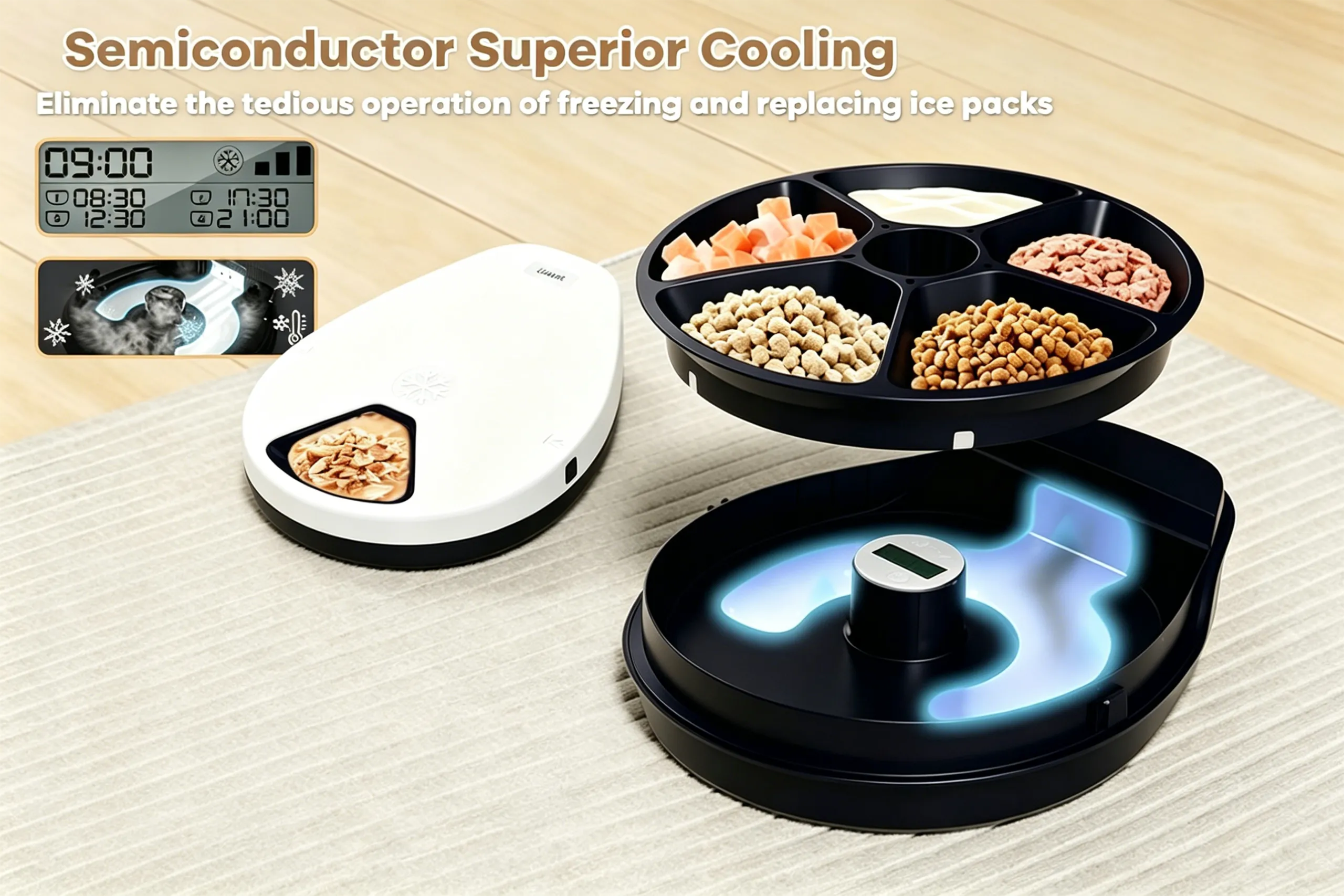
Active cooling uses a Peltier thermoelectric module — a semiconductor device that creates a temperature differential by passing electrical current through a junction of dissimilar materials. One side gets cold; the other dissipates heat. No refrigerant, no compressor, no moving mechanical parts.
In a well-designed implementation, the cold side maintains the food compartment at 35–45°F continuously, regardless of ambient temperature — up to roughly 85°F ambient, beyond which even quality Peltier systems begin to struggle to maintain the differential.
The critical limitation: Peltier cooling requires constant AC power. There is no battery backup for the cooling circuit in any current consumer-price wet food feeder. A power outage means the food starts warming immediately. For single-day scheduled feeding in a stable home, this is rarely a problem. For multi-day absences in a region with unreliable power, it’s a meaningful risk.
The Ambient Temperature Ceiling for Peltier Feeders
Consumer-grade Peltier cooling systems in wet food feeders are rated for ambient room temperatures up to approximately 85°F (29°C). Above this threshold, the cooling differential decreases — the unit cannot maintain 40°F if the surrounding air is already warm. This means:
- A climate-controlled home held at 70°F: the Peltier system works as designed, maintains safe temperature for the stated 72-hour window.
- A home that reaches 82°F in summer with AC only running during occupied hours: cooling effectiveness is reduced. The 72-hour safety window may be optimistic in practice.
- A home without AC in a warm climate: a Peltier feeder is not the right tool. Ice pack feeders with daily swap are a safer choice despite the manual intervention required.
Ice Pack vs. Semiconductor: Head-to-Head Across Every Variable
Variable | Ice Pack (Passive) | Semiconductor Peltier | Practical Winner |
Safe cooling window | 6–12 hrs (72°F room); 4–6 hrs (82°F room) | Up to 72 hrs (below 85°F ambient) | Peltier for multi-day; ice pack for single-day workday |
Power dependency | None — battery or USB timer only | Constant AC required; no battery cooling fallback | Ice pack for power-unstable homes or travel |
Ambient temp sensitivity | High — warm rooms shorten window significantly | Moderate — degraded above 85°F | Roughly equal; different failure modes |
Pre-serve warming | Keeps food cold until lid opens — cold food causes refusal in some cats | Petlibro Polar pre-warms 30 min before serving — closer to prey temperature | Peltier designs with pre-warm (Petlibro Polar) |
Meal count per fill | 4–6 trays (one fill cycle) | 3 trays (Petlibro Polar) | Ice pack feeders for high-frequency small meals |
Maintenance | Freeze packs nightly; wash trays after each cycle | Clean trays weekly; no pack management | Semiconductor for long absences; ice pack for daily discipline |
Failure mode | Pack melts — passive, gradual, visible | Cooling circuit fails — silent, abrupt; food warms undetected | Ice pack has more visible failure signal |
Price range | $40–$90 (Cat Mate C300–C500, Casfuy) | $120–$180 (Petlibro Polar, UBPET) | Ice pack significantly cheaper |
App / scheduling | Usually none (Cat Mate) or basic timer | WiFi app control, remote scheduling (Petlibro) | Semiconductor for remote access needs |
Multi-cat suitability | Better — more trays, larger portions per compartment | Limited — 3-tray design suits one cat or two with small portions | Ice pack for multi-cat or larger portion needs |
The Models That Actually Work in 2026
Rather than ranking 15 products, here are the five models with documented real-world performance for wet food, covering the key scenarios most cat owners face.
Cat Mate C500 — The Benchmark for Ice Pack Feeders
Thirty-plus years of production history. Five compartments, each holding approximately ¾ pound / 1.45 cups. Two reusable gel ice packs included. Battery operated — no power outlet required. No app, no WiFi, no firmware updates.
A 60-day independent test (autopetfeed.com, 2026) running the C500 specifically for wet food performance found it opening on schedule 98% of the time over two months, with the one missed meal attributed to low battery, not mechanical failure. Food stayed safe for 8 hours in a 72°F test environment with packs frozen solid overnight.
The limitation: 4 scheduled mealtimes maximum (5 compartments, but one is typically used as an immediate-feed). For cats requiring 5–6 small meals per day, this isn’t enough. For 2–4 mealtimes, it’s more than sufficient. No app control is the right tradeoff for this type of feeder — battery operation means no power dependency, and 3-button programming means nothing to set up, update, or troubleshoot.
Cat Mate C300 — The Single-Cat Entry Point
Three compartments, same ice pack system, lower cost ($39–$55). The right choice for single-cat households with simpler feeding schedules. The same 30+ year reliability track record applies. If you’re feeding one cat 2–3 wet meals per day and don’t need app connectivity, this is the most cost-effective safe option on the market.
Petlibro Polar — The Semiconductor Option for Multi-Day Absences
Three rotating trays, Peltier cooling maintaining food safety for up to 72 hours, app-connected via WiFi, with a 30-minute pre-warm cycle before serving — so the food is closer to room temperature when the lid opens rather than served chilled from the cold compartment.
Two engineering details worth noting. First, the anti-pinch infrared sensors on the lid edge delay closing when the cat’s head is still inside — a safety feature absent from most rotating-lid designs. Second, the stainless steel tray resists bacterial biofilm and is relevant for cats sensitive to plastic contact.
The documented limitation: three meals maximum at minimum 4-hour intervals. For cats requiring 5–6 small portion feedings per day — common for senior cats, cats with digestive sensitivities, or post-surgical feeding protocols — this is a hard constraint. The C500’s 4-tray schedule plus immediate feed option is more flexible for high-frequency feeding.
One real-world failure mode documented in reviews: the Polar motor running continuously after malfunction, rotating the serving tray and exposing refrigerated food to room air. This defeats the cooling mechanism entirely. It’s not a common failure — but if you’re relying on the feeder for a multi-day absence and this happens, the food is unsafe before you return. A cat sitter check every 2–3 days is a reasonable precaution regardless of how confident you are in the hardware.
UBPET 5-Tray Semiconductor Feeder — Higher Capacity, Unverified Claims
Five trays versus the Polar’s three, same Peltier cooling architecture, with a manufacturer claim of 4-day food safety maintenance. Larger portion capacity per compartment and more scheduling flexibility for cats requiring more meals or bigger portions.
Two caveats. First, the 4-day cooling claim is a manufacturer figure — no independent temperature-logging test has verified it under varying ambient conditions. As an OEM manufacturer that works with Peltier systems, we’d want to see logged data before endorsing a 4-day safety window for a product at this price. Second, UBPET has a shorter market history than Petlibro, which means less accumulated real-world reliability data. The same 85°F ambient ceiling applies. Worth considering when the Polar’s 3-tray limit is the deciding constraint — but verify the cooling claim against your specific room conditions before committing to multi-day use.
Casfuy 6-Tray Ice Pack Feeder — Best for High-Frequency Feeding
Six compartments, four included reusable ice packs, 1.9-inch compartment depth. Designed specifically for cats requiring multiple small meals — medication schedules, post-surgical feeding, digestive sensitivity management. At 6 trays, you can cover a full workday of 2–3 hour intervals without refilling.
The 6-tray design also means you can mix wet and dry food across compartments if needed — scheduling wet trays for early meals when the packs are coldest, transitioning to a dry tray for later in the day when the pack has warmed. This is a practical workaround for cats on combination diets that most reviews don’t discuss.
Cleaning: Non-Negotiable with Wet Food
Cleaning frequency for a dry food feeder is a preference. Cleaning frequency for a wet food feeder is a health requirement.
Wet food — even refrigerated or ice-chilled wet food — leaves protein and fat residue on every surface it contacts. That residue supports bacterial biofilm within 24–48 hours at room temperature. In a feeder where trays are reused meal after meal without washing, you’re adding fresh food to a surface that already has bacterial colonization from the previous meal.
Component | Cleaning Frequency | Method | Why It Matters |
Food trays / compartments | After every meal cycle — ideally before refilling | Dishwasher top rack (if rated) or warm soapy water; air dry completely | Primary bacterial contact surface; biofilm forms fast in protein-rich residue |
Ice pack gel pouches | Rinse after each use; inspect monthly for leaks | Rinse with warm water; no soap contact with gel material | Gel surface can harbor bacteria if not rinsed; leaking gel contaminates food |
Feeder base / tray platform | Weekly | Damp cloth with pet-safe disinfectant; fully dry before reassembly | Catches food drips and condensation from ice packs — mold growth if neglected |
Lid / cover | After every meal cycle | Warm soapy water; check hinge area for food trapping | Lid underside contacts food during serving; food particle buildup in hinges |
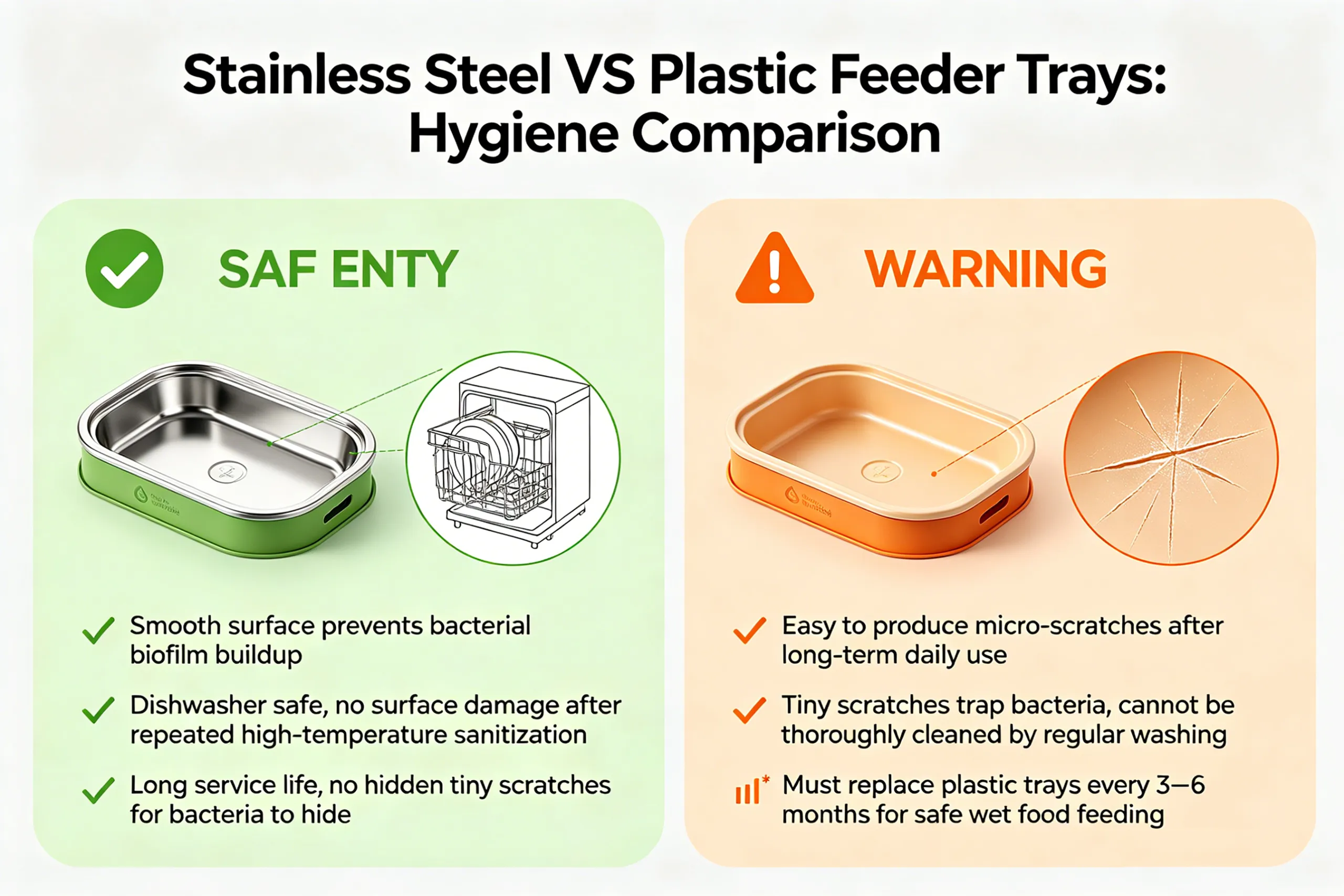
Stainless steel inserts | After every meal cycle | Dishwasher-safe; avoid abrasive pads that scratch the surface | Scratches create bacterial harbor sites that cannot be fully sanitized |
Stainless Steel vs. Plastic Trays: The Practical Difference
Stainless steel resists bacterial biofilm adhesion and can be dishwasher-sanitized without degrading the surface. Plastic scratches over time — those micro-scratches are bacterial harbor sites that soap and water cannot fully penetrate.
Decision Framework: Matching Your Situation to the Right Feeder
Your Situation | Choose | Model | Notes |
Away 8–10 hours/day, climate-controlled home, single cat | Ice pack tray feeder | Cat Mate C300 / C500 | Simplest architecture, longest track record, no power dependency |
Away 8–10 hours/day, warm home (75°F+) | Semiconductor feeder | Petlibro Polar | Ice packs degrade faster in warm rooms; active cooling more reliable |
Traveling 1–3 days, climate-controlled home | Semiconductor feeder | Petlibro Polar or UBPET | Active cooling covers multi-day window that ice packs cannot |
Cat needs 5–6 small meals per day | High-tray ice pack feeder | Casfuy 6-tray | More trays than Polar allows; flexibility for frequent feeding schedules |
Multi-cat household, wet food | Multiple ice pack feeders | Cat Mate C500 × 2 | Semiconductor feeders (3 trays) limit portion flexibility in multi-cat use |
Cat on medication timed with meals | Semiconductor or 6-tray ice pack | Petlibro Polar or Casfuy | App scheduling (Polar) or 6-tray flexibility (Casfuy) both serve medication timing |
Power-unreliable area or travel use | Ice pack feeder | Cat Mate C500 (battery) | Semiconductor feeders lose cooling immediately on power loss |
Where Common Advice About Wet Food Feeders Is Wrong
A few things that get repeated in reviews and buying guides that don’t hold up under scrutiny:
Common Misconceptions Worth Correcting
-
Myth “Any automatic feeder can handle wet food if you use ice packs.”Fact
Wrong. Hopper-and-auger feeders cannot hold wet food in sealed compartments — the food sits in an open hopper with no isolation between portions. Ice packs don’t solve the fundamental exposure problem. Only tray-rotation feeders with sealed compartments work.
-
Myth “4 hours is the safe wet food limit.”Fact
The USDA guideline for high-moisture protein in the danger zone (above 40°F) is 2 hours as the conservative safe window. Four hours is the point at which risk has already been accumulating for two hours. In a warm home above 80°F, even 2 hours may be optimistic.
-
Myth “Refrigerated feeders are always safer than ice pack feeders.”Fact
Not categorically. A Peltier feeder in a room above 85°F loses cooling effectiveness. A Cat Mate C500 with properly frozen packs in a 70°F room may maintain safer temperatures more reliably than a Peltier feeder struggling in a hot kitchen.
-
Myth “You can use a refrigerated cat feeder for raw food.”Fact
Petlibro and all current competitors explicitly state their feeders are not designed for raw food. Peltier cooling does not reach the consistent sub-40°F temperatures that raw meat safety protocols require — that needs a compressor-based system.
Frequently Asked Questions
Without any cooling: 2 hours maximum at room temperature (USDA danger zone guideline). In a warm home above 80°F, closer to 60–90 minutes. With a properly frozen ice pack: 6–12 hours depending on ambient temperature and pack size. With active Peltier semiconductor refrigeration: up to 72 hours in a room below 85°F. Food that has been in the open serving bowl after the lid opens should be removed within 2–4 hours regardless of cooling method.
No — not safely. Hopper-and-auger dry food feeders are not designed for wet or canned food. Wet food clogs the vane assembly, creates bacterial biofilm inside the hopper within hours, and has no cooling mechanism to prevent spoilage. Only tray-rotation feeders with sealed compartments and dedicated refrigerated feeders can handle wet food. If you put wet food in a dry food feeder, the best outcome is a jam and a cleaning problem. The worst outcome is spoiled food served to your cat hours later.
It depends on your absence length and home temperature. For standard 8–10 hour workdays in a climate-controlled home, a $40–$90 ice pack feeder used correctly (packs frozen solid overnight, room below 75°F) is reliable and cost-effective. For multi-day absences, or for owners who want to eliminate the daily pack-freezing routine, the $120–$180 refrigerated model justifies the premium. The Peltier system’s weakness — ambient temperature sensitivity above 85°F — is worth factoring if your home runs warm in summer without consistent AC.
Two common causes. First, temperature: refrigerated feeders serve chilled food, and many cats prefer wet food at near-room or body temperature (around 98–100°F). The Petlibro Polar addresses this with a 30-minute pre-warm cycle; ice pack feeders don’t have this. If your cat refuses refrigerated food, try warming it briefly in a separate bowl before serving. Second, novelty: some cats are startled by the tray rotating or the lid opening. A 3–5 day introduction period — leaving the feeder open and unscheduled at first, then introducing the mechanism gradually — typically resolves the aversion.
Food-contact trays and compartments should be washed after every meal cycle — not weekly. Wet food leaves protein and fat residue that supports bacterial biofilm within 24–48 hours. The feeder base and lid should be wiped down daily. A full disassembly clean, including ice pack pouches and the tray platform, is appropriate weekly. Stainless steel trays can go in the dishwasher after every cycle. Plastic trays may need replacement every 3–6 months as surface scratches accumulate.
The Manufacturer’s Perspective: What the Wet Food Feeder Category Still Gets Wrong
The wet food feeder category has improved significantly over the past three years, but two engineering problems persist across most consumer-price options.
First: the Peltier cooling system, while effective in controlled conditions, has a fundamental performance ceiling tied to ambient temperature. A compressor-based refrigeration system — like a small dedicated appliance — would solve this definitively. The reason it hasn’t arrived at consumer prices is engineering complexity and power consumption, not lack of demand. Expect this to change in the $200–$300 segment over the next 2–3 years as the category matures.
Second: there is no wet food feeder at any consumer price that provides reliable notification when food has warmed beyond the safe temperature threshold. Most refrigerated feeders tell you whether the cooling is “on” — they don’t tell you whether the food is actually at a safe temperature. A food temperature sensor with an app alert would be a meaningful safety feature that no current model provides. Ice pack feeders have no monitoring at all.
When we evaluate wet food feeder designs for OEM clients, these are the two engineering gaps we flag. The tray architecture and compartment geometry are largely solved problems — most current designs handle food dispensing and lid mechanics adequately. The unsolved problems are cooling reliability across variable ambient conditions and actual food temperature monitoring.
For buyers today: the Cat Mate C500 is still the most mechanically reliable wet food feeder for daily use in a climate-controlled home, because its simplicity eliminates the failure modes that electronic feeders introduce. The Petlibro Polar is the right tool when the absence window exceeds what ice packs can cover. Neither is perfect. Both are meaningfully better than leaving wet food in an unsuitable feeder.
Ready to Make the Next Move?
Whether you need a reliable wet food setup for your cats today, or you're a hardware brand looking to engineer the next generation of refrigerated feeders, take the next step below.
For Pet Owners: Secure the Best Options Today
As noted, the Cat Mate C500 and Petlibro Polar are currently the most reliable tools depending on your schedule. Compare them in detail to configure your home.
For Brands: Engineer the Next Generation
Let's solve the compressor-based cooling and real-time temperature monitoring gaps together. Partner with our engineering team to build the ultimate wet food feeder.
Discuss OEM/ODM Solutions



