

Cornell Feline Health Center multi-cat feeding guidelines • PetMD (Dr. Jennifer Coates, April 2026) • PreventiveVet (LeeAnna Buis CFTBS, October 2025) • Cats.com 13-feeder independent test (2026) • onlycaptions.com Petlibro RFID 4-cat household test (April 2026) • hometosight.com multi-cat feeder analysis (May 2026) • AITAKON OEM multi-cat feeder engineering assessment
Quick Answer
What is the best automatic cat feeder for two cats?
The right answer depends on one question before anything else: do your two cats eat the same food in the same portion size, or not?
-
Scenario 1
Same food, no food stealing
A dual-bowl feeder (HoneyGuaridan, Frienhund, oneisall dual-bowl) dispenses from one hopper into two stainless steel bowls on a shared schedule. Cost-effective, simple, works well for cats that eat peacefully together. Does not prevent one cat from moving to the other's bowl once both lids are open.
-
Scenario 2
Same food, one cat steals
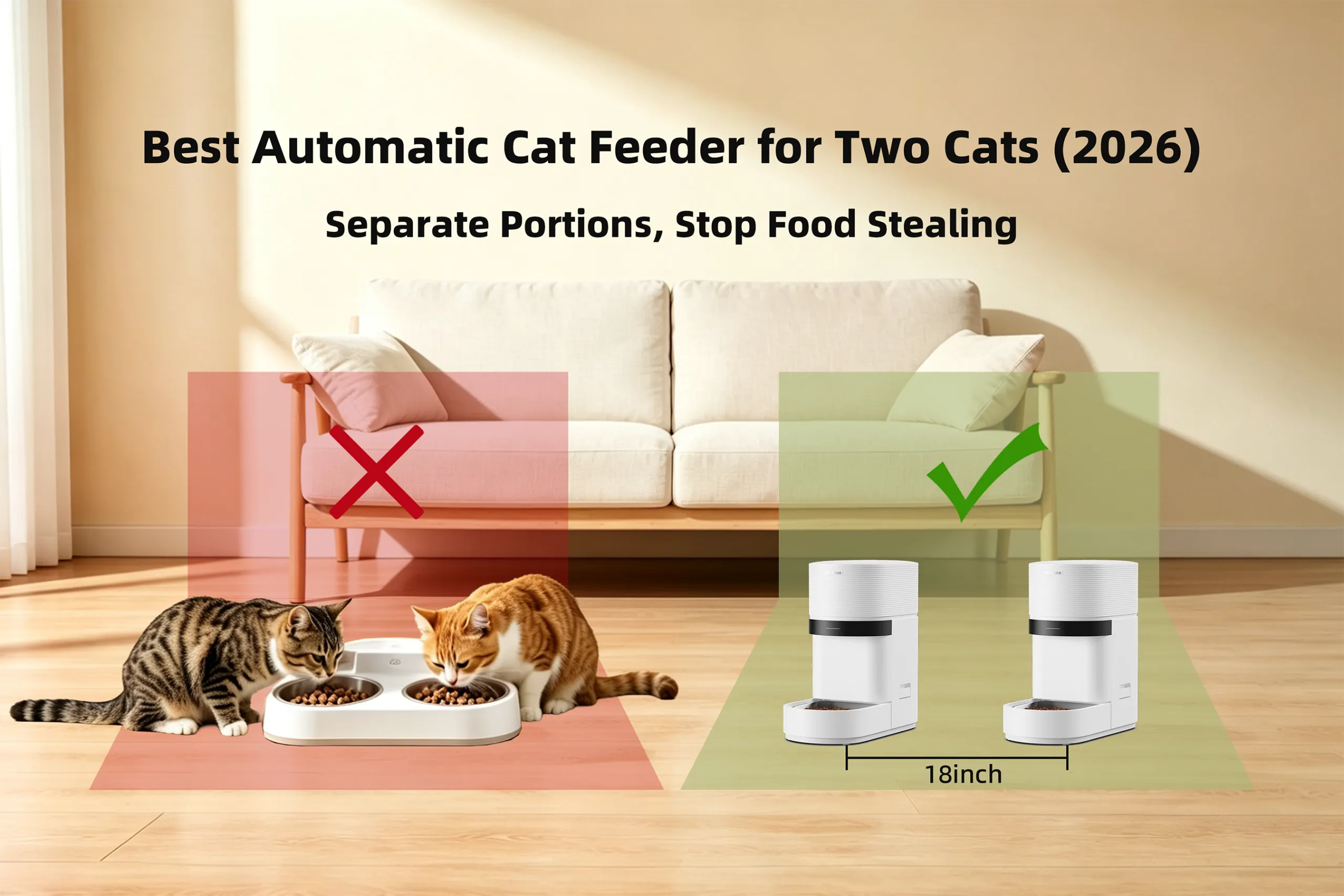
Physical spacing plus a dual-bowl feeder. Bowls positioned at least 18 inches apart with a visual barrier significantly reduces opportunistic stealing without requiring microchip technology. Works for mild food competition; not reliable for persistent food bullying.
-
Scenario 3
Different foods or different portions
Two separate feeders — one per cat. A dual-bowl feeder fed from one hopper cannot dispense different foods. You need independent units. Petlibro One RFID (one unit per cat) or two standard Granary WiFi units programmed independently is the correct architecture.
-
Scenario 4
One cat on a prescription diet
Microchip or RFID access control is non-negotiable. SureFeed Microchip (reads implanted chip, no collar required) or Petlibro One RFID (collar tag required, lower price). No other solution reliably prevents the non-prescription cat from accessing the medical diet.
Why Two-Cat Feeding Goes Wrong — and Why the Usual Fix Doesn't Work
Most advice for feeding two cats starts with “just get two bowls.” That’s not wrong, but it misses the underlying mechanics of why two-cat mealtime breaks down in the first place.
Cats are solitary hunters by nature. Unlike dogs, they didn’t evolve around communal feeding. Even cats that live together peacefully and genuinely seem to like each other retain the instinct that food is a contested resource — especially in an enclosed indoor environment where the supply is finite and controlled by the owner. According to the Cornell Feline Health Center, consistent scheduled feeding significantly reduces feline stress, specifically because it removes the uncertainty of when and how much food is available.
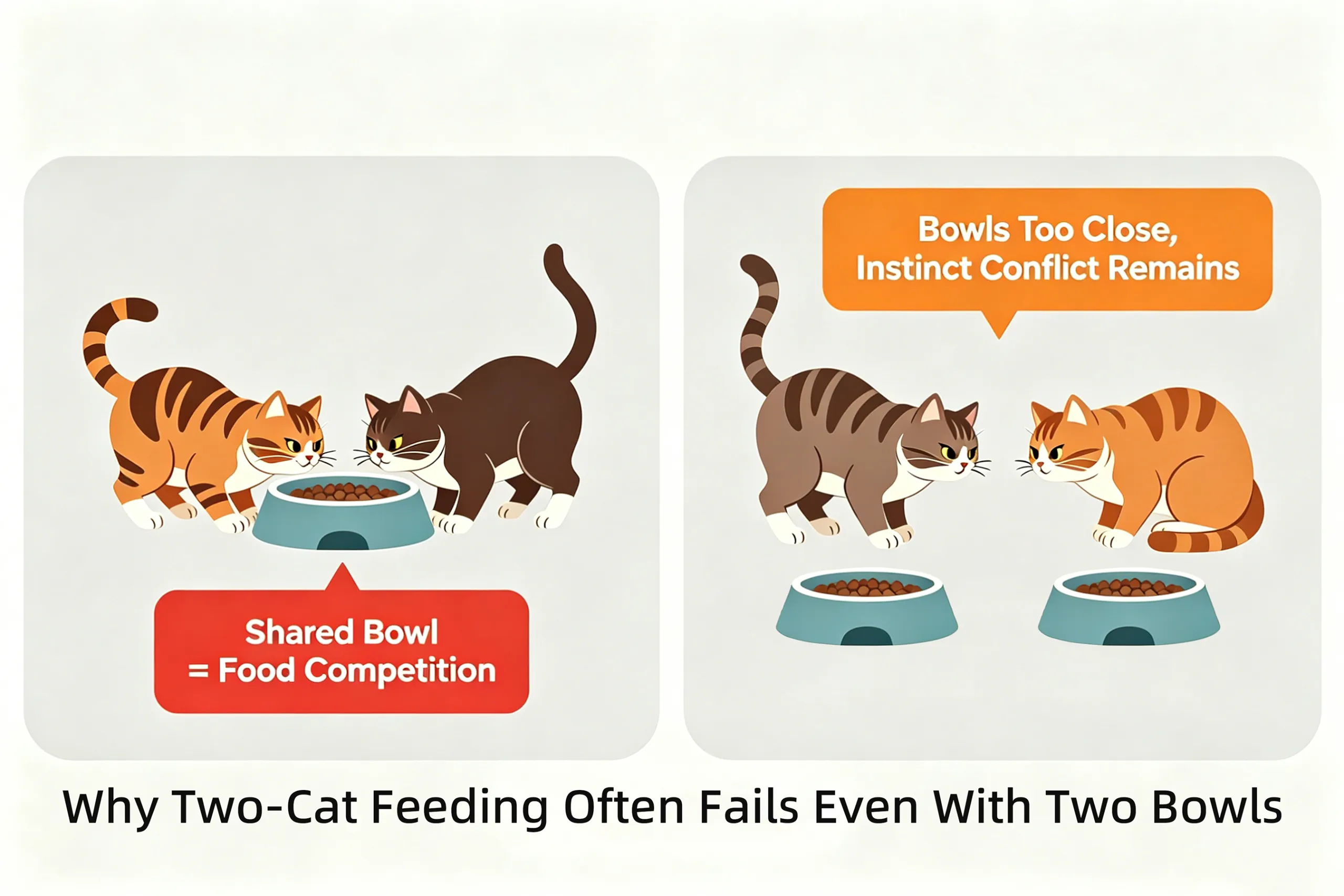
What actually goes wrong in two-cat households usually falls into one of three patterns, each requiring a different fix:
Pattern | What It Looks Like | What’s Actually Happening | Correct Fix |
Speed mismatch | One cat inhales food in 2 minutes; the other takes 10. The fast cat finishes and immediately moves to the second bowl. | Not aggression — opportunism. The fast eater isn’t being dominant; they’re responding to the presence of available food. | Physical bowl separation (18″+ apart) or slow-feed insert for the fast eater. Dual-bowl feeder with opposing bowl placement helps. |
Resource guarding | One cat stands between the other and the feeder, even when not actively eating. The subordinate cat skips meals or eats anxiously. | Territory claim on the feeding zone. The dominant cat doesn’t need to eat — controlling the resource is the behavior. | Separate feeding locations in different rooms. Staggered timing by 10–15 minutes. RFID/microchip feeder gives the subordinate cat protected access. |
Diet conflict | Two cats need different food — different calorie densities, prescription diets, or age-appropriate formulas. | A dual-bowl single-hopper feeder physically cannot serve different foods from the same hopper. | Two completely independent feeders, one per cat. RFID access control if cross-eating is a risk. |
Grazer vs. scheduled eater | One cat prefers multiple small meals throughout the day; the other eats in one or two larger portions. | Incompatible feeding rhythms that a shared schedule doesn’t accommodate. | Two independent feeders with separate programming. Cannot be solved with a shared-schedule dual-bowl unit. |
The Architecture Decision: One Feeder for Two Cats vs. Two Separate Feeders
This is the decision point most buyers skip over. Both approaches work in the right context. Here’s where each makes sense.
One Dual-Bowl Feeder: When It Makes Sense
A single feeder with two bowls dispenses from one hopper through a Y-splitter into two separate stainless steel bowls on a synchronized schedule. Both cats eat simultaneously, which naturally reduces competition — they each have their own portion delivered at the same moment.
This works well when: both cats eat the same food, both eat at roughly similar speeds, neither guards the feeding area, and portion requirements are either identical or close enough that a slight variance doesn’t matter medically.
The engineering tradeoff: a Y-splitter divides food from one hopper into two paths. The split ratio isn’t always exactly 50/50 — small variations in the vane geometry or food density can mean one bowl consistently gets slightly more than the other. For healthy cats without precise caloric requirements, this is negligible. For a cat on a weight management protocol where 10–15% over-dispensing matters, it’s worth monitoring.
The One Thing Dual-Bowl Feeders Cannot Do
A dual-bowl feeder opens both bowls at the same time. Once open, both cats can access either bowl. There is no mechanism in any dual-bowl feeder that prevents Cat A from eating Cat B's portion after finishing their own. The physical bowl separation — typically 14–18 inches on well-designed models like the Frienhund — slows opportunistic stealing by creating spatial friction. It does not stop a determined food thief.
If food stealing is the primary problem in your household, a dual-bowl feeder is the wrong tool regardless of how it's configured. Two separate feeders in different rooms — or RFID access control — is the correct solution.
Two Separate Feeders: When It’s the Right Call
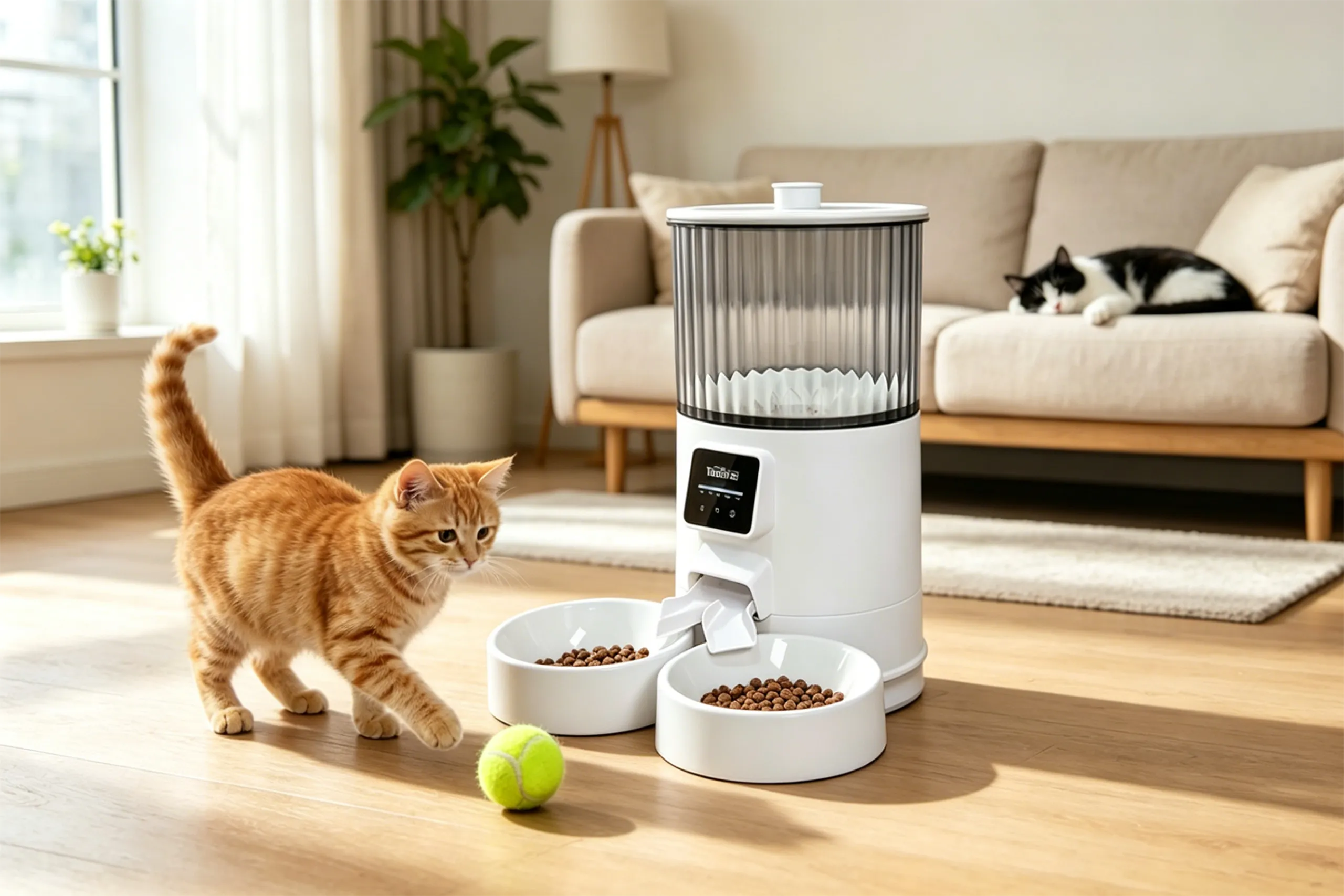
Running two independent single-cat feeders — one per cat, positioned in separate locations — is the most flexible and most reliably separation-capable setup. It costs more upfront and takes more counter space, but it solves every two-cat feeding problem that a dual-bowl unit cannot.
Two independent feeders allow: completely different food types per cat, completely different schedules (6 small meals for one cat, 2 larger ones for the other), separate portion calibration down to 1/12 cup increments, independent jam alerts and feeding logs per cat, and the ability to feed cats in separate rooms entirely if behavioral issues require it.
One documented real-world use case (onlycaptions.com, April 2026): a four-cat household using two Petlibro RFID units. One older cat received smaller, more frequent portions. Two younger cats shared one feeder with different collar tag settings. A fourth cat on a urinary prescription diet had her own feeder with specific portion calibration. The app tracked eating patterns across all four cats independently. This kind of individual health monitoring is simply not possible from a shared dual-bowl unit.
The Models That Work for Two Cats in 2026
HoneyGuaridan Dual Feeder — Best Single-Unit for Two Cats on the Same Diet
Single hopper, Y-splitter dispensing into two stainless steel bowls. 3.5L capacity. Dual-band WiFi (2.4GHz and 5GHz). App allows setting different portion sizes per bowl — which is slightly misleading, because it’s adjusting the timed dispense ratio from one hopper, not truly independent portion control. The distinction matters: you’re controlling the split of a shared food supply, not dispensing two completely separate quantities independently.
Includes two slow-feed anti-choking inserts — a genuinely useful feature for households where one cat eats too fast and regurgitates. Slow-feed geometry extends meal duration for the fast eater, which reduces both regurgitation and the speed advantage that leads to bowl-stealing. AC power with battery backup. 4.4-star rating across verified review platforms.
The bowl separation is 14–16 inches on the standard model. Adequate for most cats eating simultaneously; may not provide enough spatial separation for a cat pair with active resource guarding behavior. If your dominant cat frequently positions itself to block the subordinate cat even at this distance, the Frienhund’s wider 18.7-inch separation is worth the upgrade.
Frienhund Dual Feeder — Best for Households with Mild Food Competition
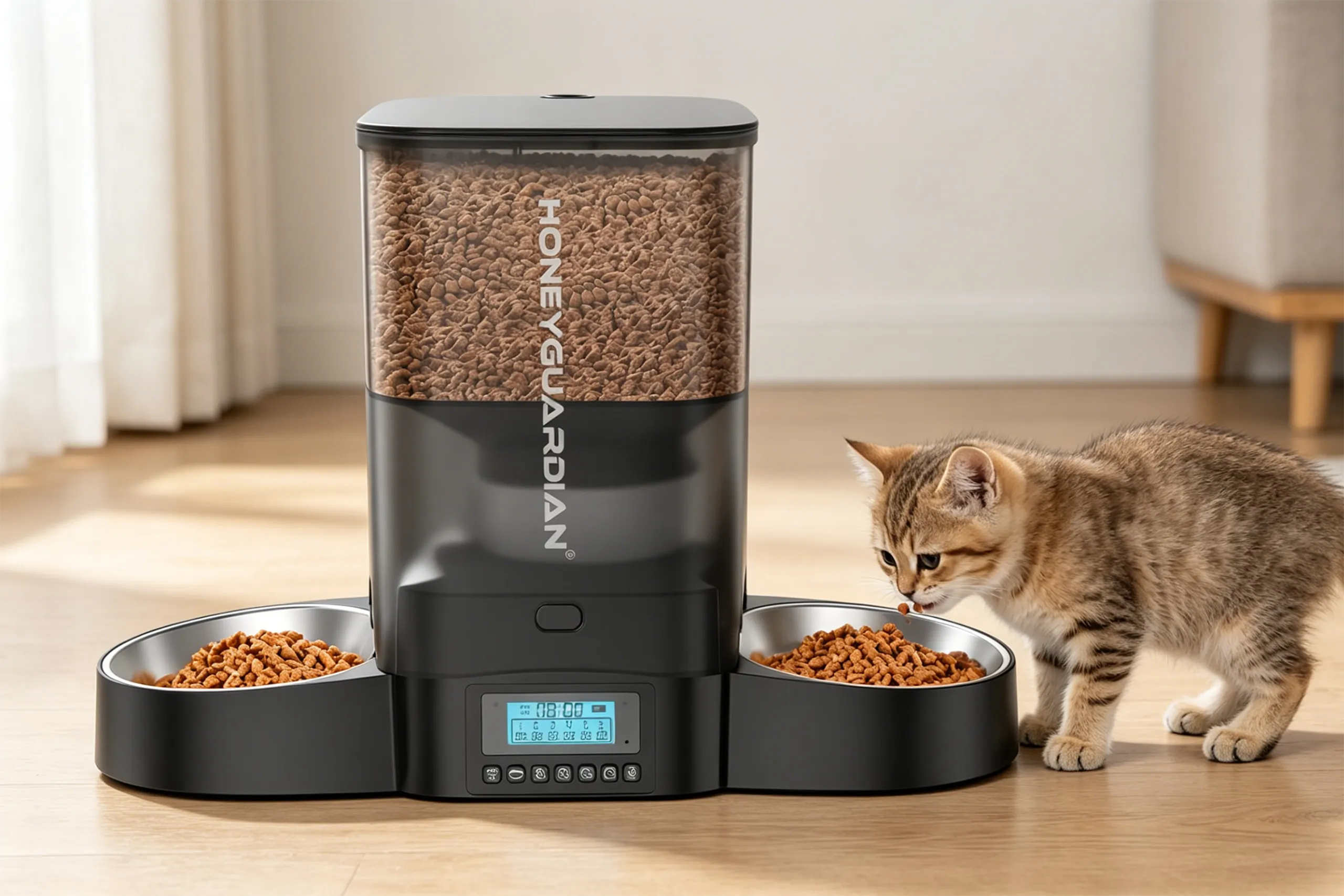
The key engineering difference from the HoneyGuaridan: 18.7-inch bowl separation with a center divider. Veterinary behaviorists note that 11 inches is the minimum recommended separation to reduce territorial tension at simultaneous feeding — the Frienhund’s 18.7-inch span goes meaningfully beyond that minimum.
7L hopper capacity — larger than most dual-bowl options, which matters in a two-cat household where you’re feeding two cats from one hopper. Dual-band WiFi, app scheduling up to 30 meals per day. Anti-tip design with optional carabiner attachments to secure the unit against food-motivated cats knocking it over. For households where one cat is physically larger and more assertive, the carabiner option matters.
Petlibro One RFID (Pair) — Best for Two Cats with Different Diets
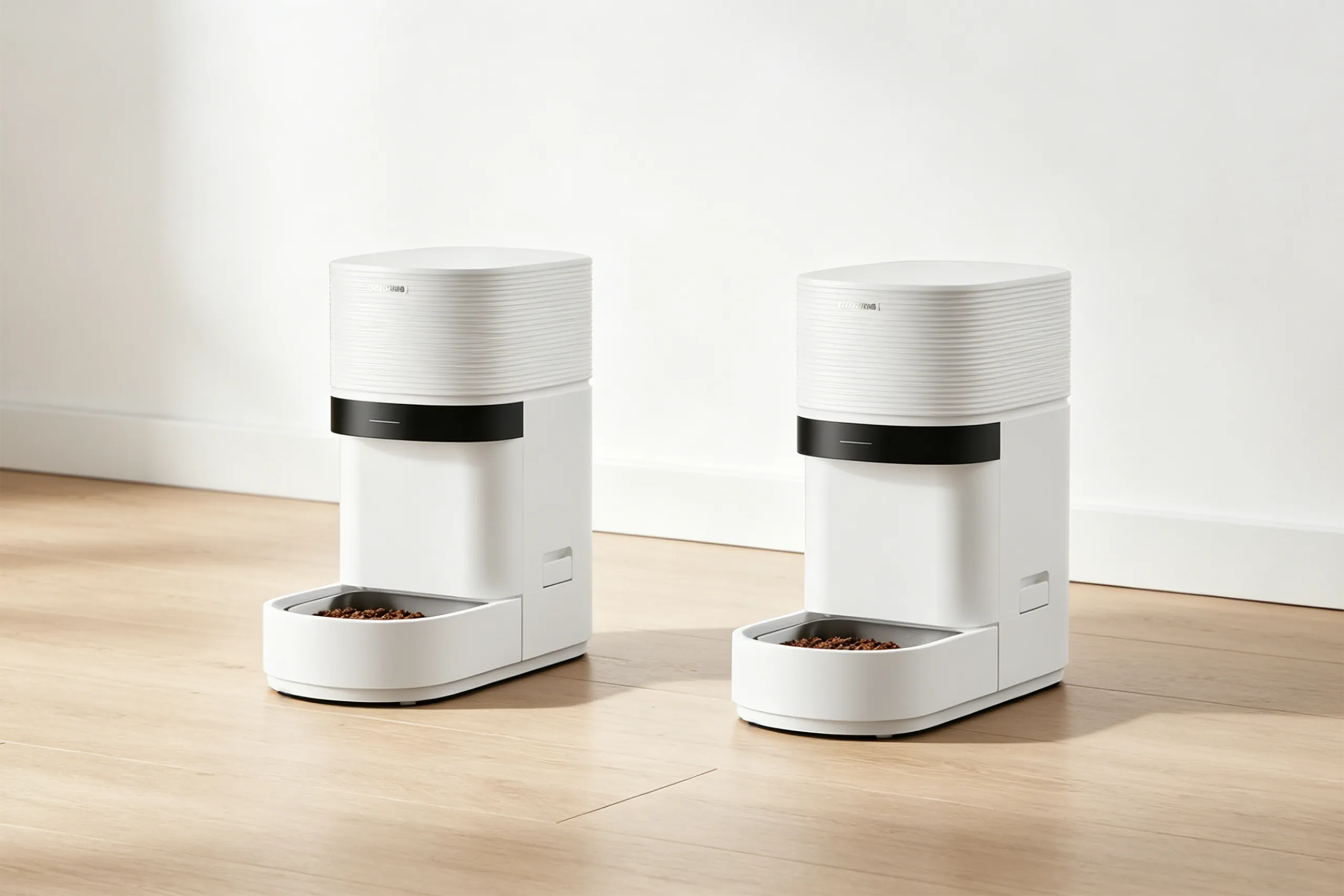
Running two Petlibro One RFID units — one per cat — is the most complete solution for two-cat households with dietary separation needs. Each unit reads the collar-mounted RFID tag for its registered cat and remains closed to the other. Cats can eat simultaneously without access to each other’s food, at different times without the other having unsupervised access, or in completely separate rooms if behavioral management requires physical separation.
App-connected, with individual eating logs per unit. The logs provide data that dual-bowl feeders cannot: exactly when each cat ate, for how long, and whether they came back for a second visit. In a household where one cat is losing weight unexpectedly, this visibility is diagnostically useful before a vet visit.
Practical note: RFID collar tags require cats to wear collars. Both cats must wear their respective tags consistently. For cats that remove or lose collars, this is a reliability issue. The Petlibro tag weighs approximately 4 grams — lighter than most breakaway hardware — but some cats will still work to remove it. Allow 1–2 weeks of collar adaptation before relying on the RFID system for prescription diet compliance.
SureFeed Microchip Feeder (Pair) — Best for Prescription Diet Separation
SureFeed reads the implanted microchip — no collar required. This is the critical difference from Petlibro One RFID and the reason SureFeed is the standard veterinary recommendation for households where one cat must eat a specific medical diet and the other must not access it under any circumstances.
The lid mechanism closes when the registered cat steps away, sealing the food. This means even if Cat B approaches while Cat A is still eating, the lid closes the moment Cat A backs away — not just on a timer. The behavioral consequence is meaningful: Cat B learns very quickly that the bowl is inaccessible, which reduces the persistent food-guarding behavior that open-bowl timing systems create.
The SureFeed Connect model adds app connectivity: eating logs, real-time alerts if a cat fails to eat, and weight tracking (the unit measures food weight consumed per session). For a cat on a prescription renal or diabetic diet where appetite change is a key early warning sign, these logs have genuine clinical value.
Price premium is real: approximately $170–$190 per unit. Two units for a two-cat household is a $340–$380 investment. For households where dietary separation is a medical requirement rather than a convenience preference, the cost is justified. For households where food stealing is behavioral rather than medical, the Petlibro One RFID pair at approximately $300 is a reasonable alternative.
Two Standard Granary WiFi Units — Best for Independent Scheduling, Same Food
If your cats eat the same food but need completely different schedules — different meal frequencies, different portion sizes, one grazes and one eats scheduled meals — two standard Petlibro Granary WiFi units (one per cat) gives you full independent programming without RFID hardware costs.
Each unit has its own app profile, its own schedule, its own jam alert, and its own feeding log. You can place them in the same room or different rooms depending on your household dynamics. Total cost is approximately $200 for two units — cheaper than two SureFeed Connect units and more flexible than a single dual-bowl feeder for cats with divergent scheduling needs.
The limitation: no access control. This setup only works if your cats don’t actively steal from each other’s feeders. If one cat approaches and eats from the other unit, you’re back to the same problem with twice the hardware.
What Owners and Independent Testers Report (2025–2026):
"The concept of 'this is my bowl, and that is not my bowl' is not something your cat understands. Food is food."
"Food bullying is rarely about aggression — it's about security."
"One older cat received smaller, more frequent portions. Two younger cats shared one feeder but with different collar tag settings. The fourth cat, on a special urinary health diet, had her own feeder with portions calibrated for her specific needs."
"In a multi-cat home with one cat on a prescription diet, feeding them separately has several benefits. Diets often need to be tailored to a cat's age, lifestyle, and health."
Full Comparison: Every Architecture for Two Cats
Setup | Same Food? | Separate Portions? | Prevents Stealing? | Separate Schedules? | Price (~) | Best For |
Dual-bowl feeder (HoneyGuaridan / Frienhund) | Required | Approximate ratio only | No — spatial friction only | No — shared schedule | $80–$120 | Same diet, peaceful eaters, convenience-focused households |
Two standard feeders (Granary WiFi x2) | Either | Yes — fully independent | No — no access control | Yes — fully independent | ~$200 | Different schedules, same food, no active stealing |
Petlibro One RFID x2 | Either | Yes — fully independent | Yes — collar RFID tag | Yes — fully independent | ~$300 | Different diets, mild-to-moderate food stealing, collar-tolerant cats |
SureFeed Microchip x2 | Either | Yes — plus weight tracking | Yes — implanted microchip | Yes — fully independent | ~$360 | Prescription diet compliance, no-collar households, vet-managed diets |
Physical room separation + any feeder | Either | Yes | Yes — architectural | Yes | Feeder cost only | Severe food aggression or resource guarding requiring full spatial separation |
Bowl Placement: The Variable Most Guides Skip Over
Even with the right feeder, placement decisions affect whether the setup actually works. A few principles drawn from feline behavioral research and real-world testing:
Placement Rules That Make a Real Difference
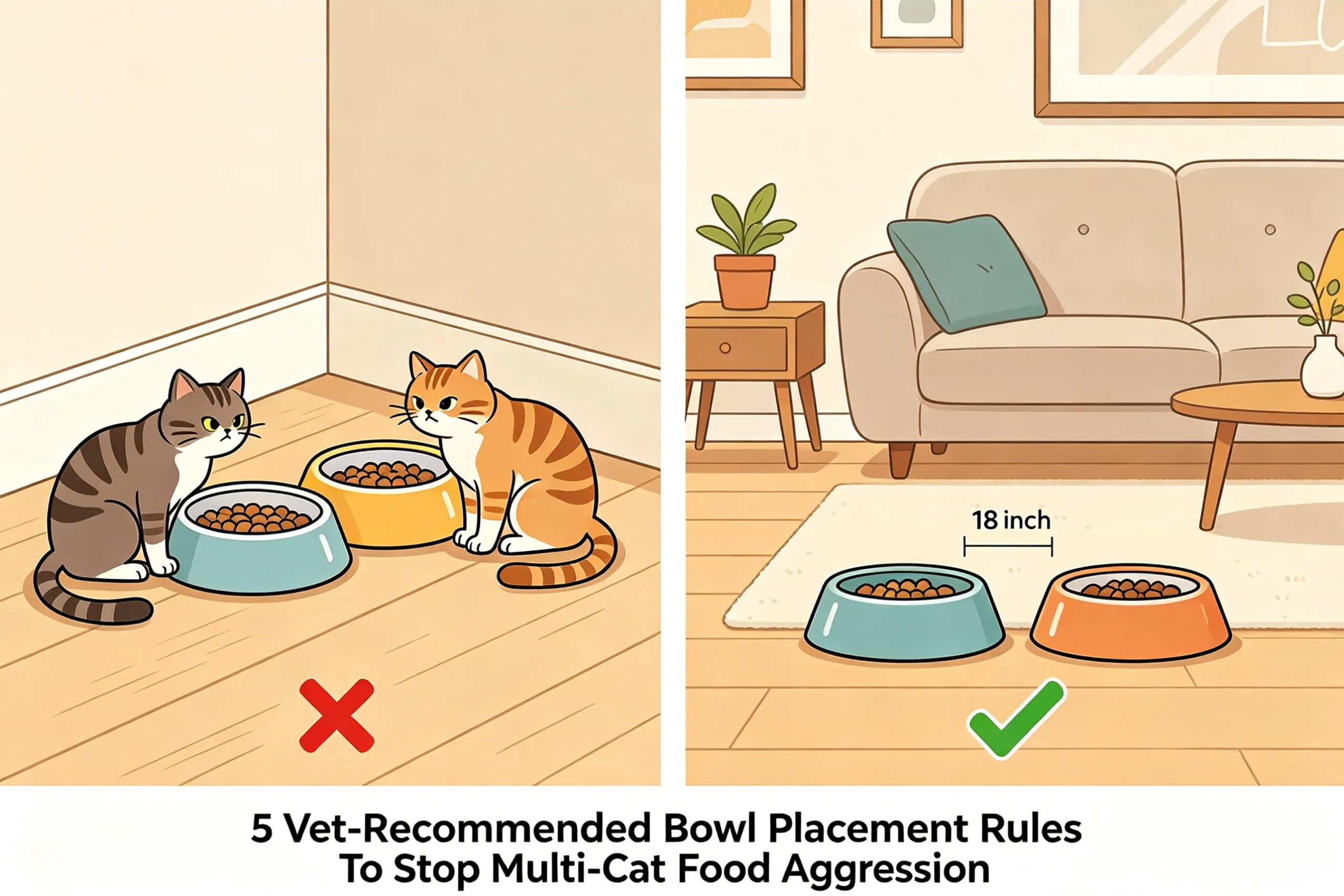
- Minimum 18 inches between bowls for simultaneous feeding. Veterinary behaviorists recommend at least 11 inches as a minimum to reduce territorial tension. 18+ inches creates enough spatial separation that most cats perceive their bowl as a distinct resource, not a contested one.
- Avoid corners and dead ends. A cat eating in a corner has limited escape routes if the other cat approaches. Cats that feel trapped at the feeder eat faster, eat more anxiously, or avoid the feeder altogether. Position feeders with clear sightlines and multiple exit directions.
- At the same height whenever possible. Height differentials can create implicit hierarchy around the feeding station. Same-height bowls reduce the dominance signaling that elevated positions create in some cats.
- Scent-mark the feeding area. Cats rub cheeks on areas they claim. A dominant cat that consistently rubs the feeder area is establishing territorial ownership. Wiping the feeder base with a pet-safe cleaner weekly disrupts persistent scent marking and reduces the territorial investment the dominant cat develops around the feeding zone.
- Consider feeding in separate rooms for new introductions. If you're introducing a second cat to a household with an established resident cat, feed them in separate rooms with a closed door for the first 2–4 weeks before transitioning to same-room feeding with separated stations.
Slow-Feed Inserts: The Overlooked Tool for Speed Mismatch
One of the most common two-cat feeding problems isn’t food stealing in the territorial sense — it’s a speed mismatch. One cat eats in 2–3 minutes; the other takes 8–10. The fast eater finishes, approaches the other’s bowl, and eats the remainder before the slow eater gets back to it. This isn’t aggression. It’s opportunism, and it doesn’t respond to the same solutions as resource guarding.
Slow-feed bowl inserts — maze-style patterns that force cats to work around obstacles to reach kibble — extend meal duration for fast eaters to 6–8 minutes per portion. Some dual-bowl feeders (HoneyGuaridan, for example) include slow-feed inserts as standard. For those that don’t, third-party stainless steel slow-feed inserts sized for the feeder bowl are widely available.
The engineering reason slow-feed works in this context: if both cats finish within a similar timeframe, there’s no opportunity window for the fast eater to approach the slow eater’s bowl while food is still available. The slow eater’s bowl becomes empty at roughly the same moment as the fast eater’s, eliminating the behavioral trigger without requiring access control hardware.
When Slow Feed Alone Isn't Enough
Slow-feed inserts solve the speed mismatch problem. They do not solve resource guarding. If your dominant cat positions itself near the feeder between meals, blocks the other cat's approach, or eats its own meal normally but then guards the empty bowl — that's territorial behavior that requires spatial separation or access control, not a slow-feed insert.
The Behavioral Test
Observe your dominant cat's post-meal actions to apply the correct fix:
Cat eats and then stays near the feeder (watching or blocking access).
Cat eats first and then leaves the area immediately.
Portion Control for Two Cats: Why One Feeder Usually Gets This Wrong
Weight management in a two-cat household is one of the more common reasons people upgrade to an automatic feeder — typically because one cat is overweight and free-feeding makes individual caloric control impossible.
A dual-bowl feeder fed from one hopper can approximate different portions per bowl by adjusting the dispense ratio, but it cannot guarantee per-bowl accuracy because kibble flow through a Y-splitter is affected by kibble shape, density, and hopper fill level. In practice, you’ll see variance — sometimes meaningful variance — between what was programmed and what each bowl received.
For a cat on a weight management protocol with a specific daily caloric target, two independent feeders give you fully reliable per-cat portion control. The Petlibro Granary dispenses at approximately 10g / 1/12 cup per portion. Two independent units means Cat A gets exactly the programmed schedule, and Cat B gets exactly its programmed schedule, with independent jam alerts if either unit blocks.
The Calorie Conversion Step Everyone Skips
Automatic feeders dispense by volume, not by calorie. A standard 1 portion setting on a Petlibro unit equals approximately 10 grams of food. However, identical volumes of different kibble formulations carry vastly different energy densities:
The takeaway is clear: the same number of portions = meaningfully different caloric intake depending entirely on the specific kibble brand and recipe you use.
Practical Two-Cat Case Study:
In a two-cat household where Cat A needs 200 kcal/day and Cat B needs 280 kcal/day, you need to calculate exactly how many portions of your specific kibble deliver those targets — do not just blindly rely on a generic strategy like "fewer portions for the diet cat."
This basic two-minute math step eliminates the single most common reason automatic feeders "don't work" for weight management when the device hardware is otherwise functioning perfectly.
Frequently Asked Questions
Yes — with a dual-bowl feeder that dispenses into two separate bowls simultaneously. This works well for two cats eating the same food with similar portion needs. What a single feeder cannot do is feed two cats different food types, guarantee truly independent portions (the Y-splitter split ratio has natural variance), or prevent one cat from accessing the other's bowl once both are open. If dietary separation or portion precision is required, two independent feeders is the correct setup.
The fix depends on whether the problem is speed mismatch or resource guarding. For speed mismatch: add a slow-feed insert to the fast eater's bowl, extending their meal time to match the slower eater. For mild stealing: increase physical bowl separation to 18+ inches and add a visual barrier between bowls. For persistent food stealing or prescription diet protection: the only reliable solution is RFID or microchip access control (Petlibro One RFID or SureFeed Microchip) — one unit per cat, with access granted only to the registered animal.
Not always. A dual-bowl feeder works for two cats that eat the same food, don't have active food stealing problems, and don't need independent schedules. You need two separate feeders when: the cats eat different foods, one cat needs a prescription diet, their portion requirements differ significantly, they have different feeding schedules, or one cat consistently steals from the other despite physical separation. When in doubt, two separate feeders is the more flexible and long-term reliable setup.
Two completely separate feeders — one per cat. A dual-bowl feeder fed from one hopper cannot serve two different food types. The choice of feeder depends on whether dietary protection (preventing the wrong cat from accessing the other's food) is required. If yes: Petlibro One RFID (collar tag, approximately $149/unit) or SureFeed Microchip (implanted chip, no collar, approximately $170–$190/unit). If no active food stealing occurs: two standard Petlibro Granary WiFi or Air units, one per cat, programmed independently.
Two cats can physically eat from the bowl of a single Petlibro Granary or Air, but there is no portion separation — whichever cat reaches the bowl first eats whatever is dispensed. For two cats on the same food in similar quantities who don't compete for food, this works. For separate portions, separate diets, or any household with active food stealing, run one Petlibro One RFID unit per cat. The One RFID is specifically designed for exactly this scenario — each unit opens only for its registered collar tag, preventing cross-access regardless of timing.
For simultaneous feeding from a dual-bowl unit: at least 18 inches between bowls, with a center divider if possible. For two separate feeders in the same room: at least 24 inches apart, positioned so each cat has a clear sightline and unobstructed exit route from their feeding station. For resource guarding situations: separate rooms with a closed or partially-closed door is more reliable than any fixed distance in the same space. The Petlibro One RFID documentation specifically recommends 25cm+ (approximately 10 inches) between two RFID units to avoid read interference — not for behavioral spacing, but to prevent the RFID sensor of one unit from being triggered by the collar tag intended for the other.
The Manufacturer's Perspective: What a Two-Cat Feeder Setup Actually Needs to Solve
From an OEM design perspective, the two-cat feeder market splits into two genuinely different product categories that are often marketed as the same thing.
The first category is convenience feeders for two cats — dual-bowl designs that automate scheduled feeding for cats that would eat fine from two manual bowls anyway. These are legitimate products. The engineering goal is portion dispensing on a schedule, and most current dual-bowl units achieve that reliably. Their limitation is that they don’t change the fundamental feeding dynamic — they just automate it.
The second category is access-control feeders for two cats with conflicting dietary needs. This is a harder engineering problem, and it’s where the category is still developing. RFID collar tags are the current mainstream solution because they’re lower cost than microchip readers and technically simpler to implement. The weakness — collar dependency — is real and acknowledged by everyone in the category. Microchip reading solves the collar problem but adds cost and reader complexity.
The gap in the market: a dual-bowl feeder with per-bowl RFID access control. Both bowls open from one unit, each controlled by a separate RFID tag. This would serve the majority of two-cat households with dietary separation needs at lower cost and counter-space footprint than two independent units. The engineering challenge is preventing read interference between the two sensors at close proximity. It’s a solvable problem — it just hasn’t been solved at a consumer price point as of mid-2026.
For buyers today: two independent RFID units is the current best-available solution for dietary separation. It’s not elegant, but it works reliably when correctly configured.
Where Do We Go From Here?
Whether you need a reliable feeding setup for your cats today, or you're a hardware brand looking to capture the unmet market demand, take the next step below.
For Pet Owners: Build Your Setup Today
As noted, two independent units are currently the most reliable fix for dietary separation. Compare the best-tested models to configure your home.
For Brands: Engineer the Market Gap
Let's solve the dual-sensor RFID interference challenge together. Partner with our engineering team to build the unified, access-controlled dual feeder the market is waiting for.
Discuss OEM/ODM Solutions



