

Quick Answer
Are self-cleaning litter boxes safe for cats?
Documented entrapments and fatalities trace directly to this design: a vertical rotating drum with a star-shaped or oblong entry that closes on cats if sensors fail. Multiple feline deaths were linked to cheap, unbranded units sold on Amazon (such as 'Amztoy', since removed). In a June 2025 New York lawsuit, an Autoscooper 11 unit killed a cat named Sarabi; the $3 million lawsuit against manufacturer Pet Pivot remains ongoing as of September 2026.
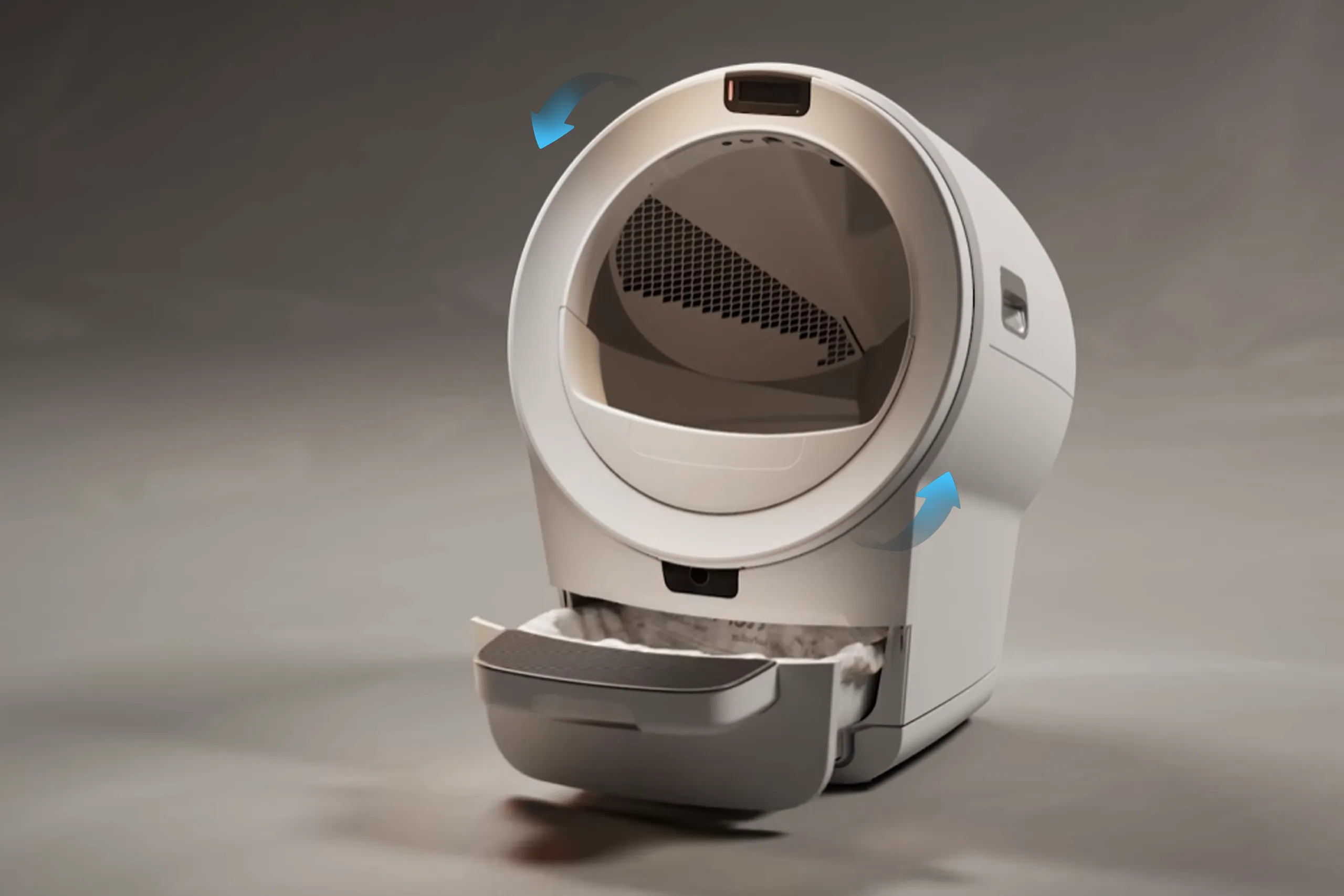
Established globe-style units from Whisker (Litter-Robot 4, Litter-Robot 5) and equivalent premium brands use an entirely different architecture: the globe rotates horizontally (X-axis) while the entry opening remains permanently accessible throughout the entire cycle. Furthermore, an integrated physical over-torque protector stops and reverses the motor under mechanical resistance — making entrapment impossible even during total sensor failure.
What Owners and Independent Reviewers Report About Safety (2024–2026):
“A Siamese cat named Mochi was killed when the device closed on its neck. Another user reported a 3-month-old kitten named Charly was killed in the same manner.”
Mechanism Analysis: Cats.com verified the fatal design flaw: the unit operates on a vertical (Y-axis) rotation with an oblong opening that acts as a guillotine-style closing door. Philip Bloom (One Man Five Cats YouTube channel) replicated the incident using a plush test cat, confirming the automatic closure mechanism. While Amazon delisted the 'Amztoy' listing, identical hazardous units continue to appear under altered white-label names across Amazon, Wayfair, and AliExpress.
“A Bronx woman came home to find her cat, Sarabi, dead, partially stuck inside her Autoscooper 11 litter box. The lawsuit claims a ‘catastrophic failure of the product’s safety mechanisms’ led to Sarabi’s death.”
Legal Context: A $3 million lawsuit filed in June 2025 against manufacturer Pet Pivot and Amazon remains ongoing as of September 2026. Despite marketing claims that the unit remains "partially open at all times without full enclosure," the tragic failure demonstrates the risks of motor-driven closing apertures. (Editorial note: AITAKON cannot independently verify the mechanical defect claims or court proceedings).
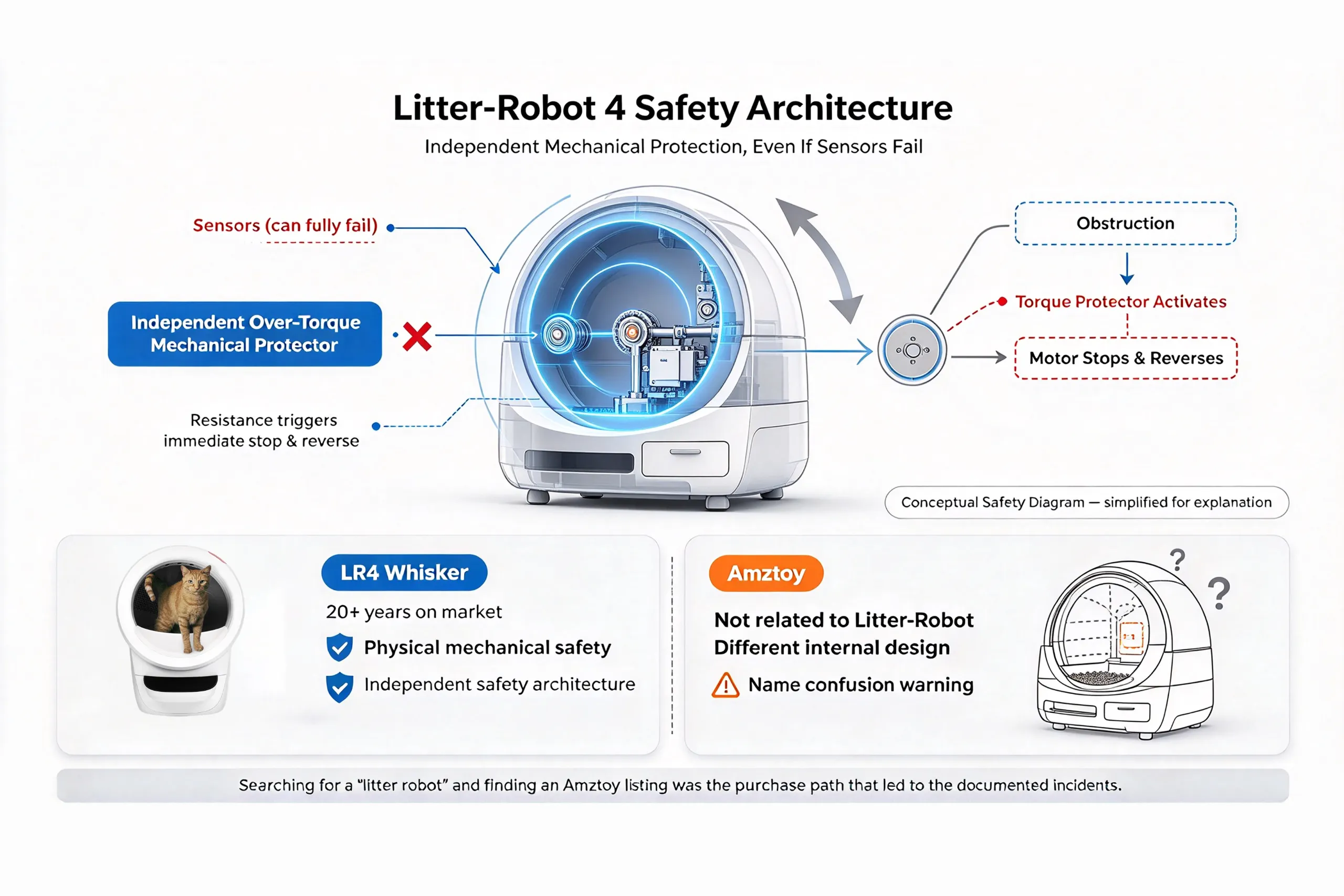
“The Litter-Robot 4 has been designed so that even if somehow all the sensors fail, the motor has a built-in over-torque protector which detects any resistance and will stop and move back instantly.”
Architectural Redundancy: Unlike budget drum designs, the LR4 relies on a non-electronic, mechanical fail-safe. If all software sensors fail simultaneously, physical resistance against the globe immediately trips the over-torque sensor, stopping and reversing the motor. Entrapment is physically prevented by design, regardless of sensor status.
“It’s important to note that the Amztoy product is not related to the popular Litter-Robot brand, which has been on the market for 20+ years and has an excellent safety record.”
Counterfeit Search Trap: Cheap knock-offs aggressively co-opt the phrase "Litter Robot" in search metadata while selling fundamentally hazardous vertical-drum mechanics. Whisker and Amztoy share zero supply chain, manufacturing, or corporate ties. The documented accidents stemmed directly from buyers searching for genuine Litter-Robot models and mistakenly purchasing deceptive imitations.
The Two Design Categories: A Safety Question About Mechanism, Not Brand
The safety question about automatic litter boxes is not a question about brands or price points in general — it is a question about mechanism design. Two fundamentally different design architectures exist in the category, and they have completely different safety profiles. Understanding the distinction eliminates the concern about automatic litter boxes as a category and directs appropriate caution toward the specific design type responsible for the documented incidents.
The Dangerous Design: Vertical Rotation With a Closing Entry
The design responsible for every documented feline fatality in the category shares three characteristics: it rotates on a vertical axis (Y-axis rotation, like a Ferris wheel rather than a horizontal spin), its entry is a single piece of plastic that forms a defined hole which closes during rotation, and its sensor system provides the only mechanism preventing a cat from being caught by the closing entry — with no physical backup if sensors fail.
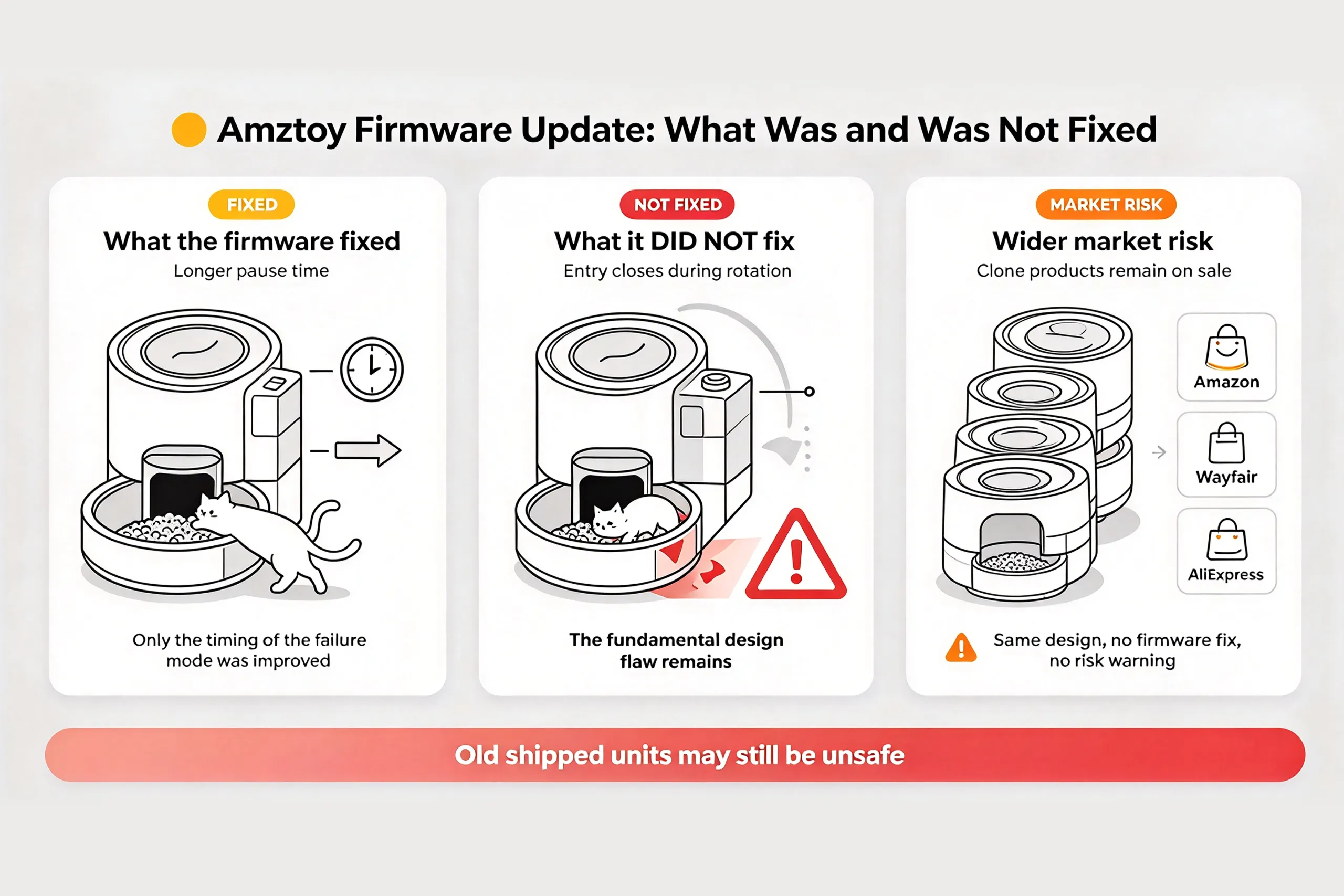
The failure mode is not subtle: if the sensor fails to detect a cat at the entry point, the mechanism rotates and the entry hole acts as a mechanical pinch point. Philip Bloom’s demonstration using a plush cat toy — documented on his One Man Five Cats YouTube channel — showed clearly that a cat positioned halfway through the entry during rotation would be caught by the closing mechanism. Amztoy’s response was a firmware update that extended the sensor pause time before rotation resumed. This update addressed the software gap but not the underlying design flaw: the entry still closes during the cycle, and a cat in the entry path during rotation remains at risk if the sensor produces a false-negative reading.
The Safe Design: Horizontal Rotation With an Always-Open Entry
Globe-style units from established manufacturers — the Litter-Robot 4, Litter-Robot 5, and equivalent premium designs — rotate on a horizontal axis (X-axis). The globe spins around its equator. The entry opening is in the upper portion of the globe and, critically, remains accessible throughout the entire cleaning cycle. As the globe rotates, the opening moves slightly but never closes — a cat can enter or exit the globe at any point during the rotation because there is no door, no closing mechanism, and no pinch point.
The over-torque protector is the physical safety backup that makes the safe design’s entrapment risk essentially zero even in the event of complete sensor failure. If any object — a cat’s paw, tail, or body — creates resistance to the globe rotation, the motor load increases immediately, the over-torque sensor detects this resistance, and the motor stops and reverses within milliseconds. This happens regardless of the state of the weight sensors or curtain laser sensors. It is a physical, non-electronic backup that cannot be defeated by sensor fouling, calibration drift, or firmware errors.
The Documented Incidents: What Actually Happened
The incidents that drive the ‘are automatic litter boxes safe?’ search question are real and documented. Presenting them accurately — with the specific design involved, the mechanism of failure, and the design distinction that separates them from established safe products — is more useful to cat owners than either dismissing them or treating them as category-wide evidence.
The Amztoy Design: Why the Firmware Update Was Insufficient
The Amztoy response to reported fatalities was a firmware update that extended the duration of the sensor pause before the mechanism resumed rotation after detecting a cat. This update addressed one contributing factor — the pause duration was too short for a cat to safely exit — but it did not address the fundamental design flaw: the entry hole still closes during rotation. A cat positioned in the entry at the point when the pause ends remains at risk. The update improved the timing of the failure mode without eliminating the failure mode.
Critically, the firmware update was not pre-installed on units that had already been shipped. Owners who purchased the unit before the update was released were running unfixed devices. Cats.com and Philip Bloom noted that identical designs continued to be sold under dozens of different brand names across Amazon, Wayfair, and AliExpress after Amztoy’s specific listing was removed — none of them necessarily carrying the updated firmware or any disclosure of the design risk.
The Four Safety Features That Define a Safe Automatic Litter Box
Before any cat uses an automatic litter box, four safety features should be confirmed in the manufacturer’s published documentation. The absence of any one of these features is a meaningful safety risk; the absence of all four characterises the design type linked to documented fatalities.
|
Safety Feature |
What It Does |
Why It Matters |
Red Flag If Absent |
|
Open-entry design (entry never closes during cycle) |
The entry opening remains physically accessible throughout the entire cleaning cycle — it may move slightly but never closes or creates a pinch point |
This is the primary physical safety property. An entry that closes during the cycle is the mechanism responsible for every documented feline fatality in the category. No sensor reliability improvement compensates for a closing-entry design |
Product video shows entry rotating to a closed position; entry described as a ‘door’; vertical (Y-axis) Ferris-wheel-style rotation |
|
Physical over-torque / motor stall protection |
The motor halts and reverses immediately when it encounters resistance above its operating threshold — regardless of sensor state |
Provides a non-electronic safety backup that operates even in the event of complete sensor failure. Cannot be defeated by dust fouling, calibration drift, or firmware errors |
No mention of over-torque protection in specifications; no independent mechanical test data available; mechanism type makes physical backup impossible (closing-door designs) |
|
Dual-sensor detection (weight + motion/infrared/radar, both required to clear) |
Two independent detection methods must both register cat-exit before the cycle delay timer starts |
Single-sensor designs have a single failure point — one sensor malfunction can alone trigger a premature cycle. Dual-sensor redundancy means one sensor failure cannot alone start the mechanism |
Only one sensor type described; sensor described generically as ‘infrared’ without specifying type count or redundancy; no documentation of fail-safe default state |
|
Configurable cycle delay (minimum 3 minutes after cat exit) |
The mechanism waits a configurable minimum time after exit detection before beginning the cleaning cycle |
Provides time for the cat to fully leave the area and for clumps to finish forming. Prevents premature activation if a cat re-enters quickly |
Fixed, non-configurable delay under 3 minutes; no delay documentation; delay mentioned only in marketing language without a stated minimum |
Which Cats Are — and Aren't — Suitable for Automatic Litter Boxes
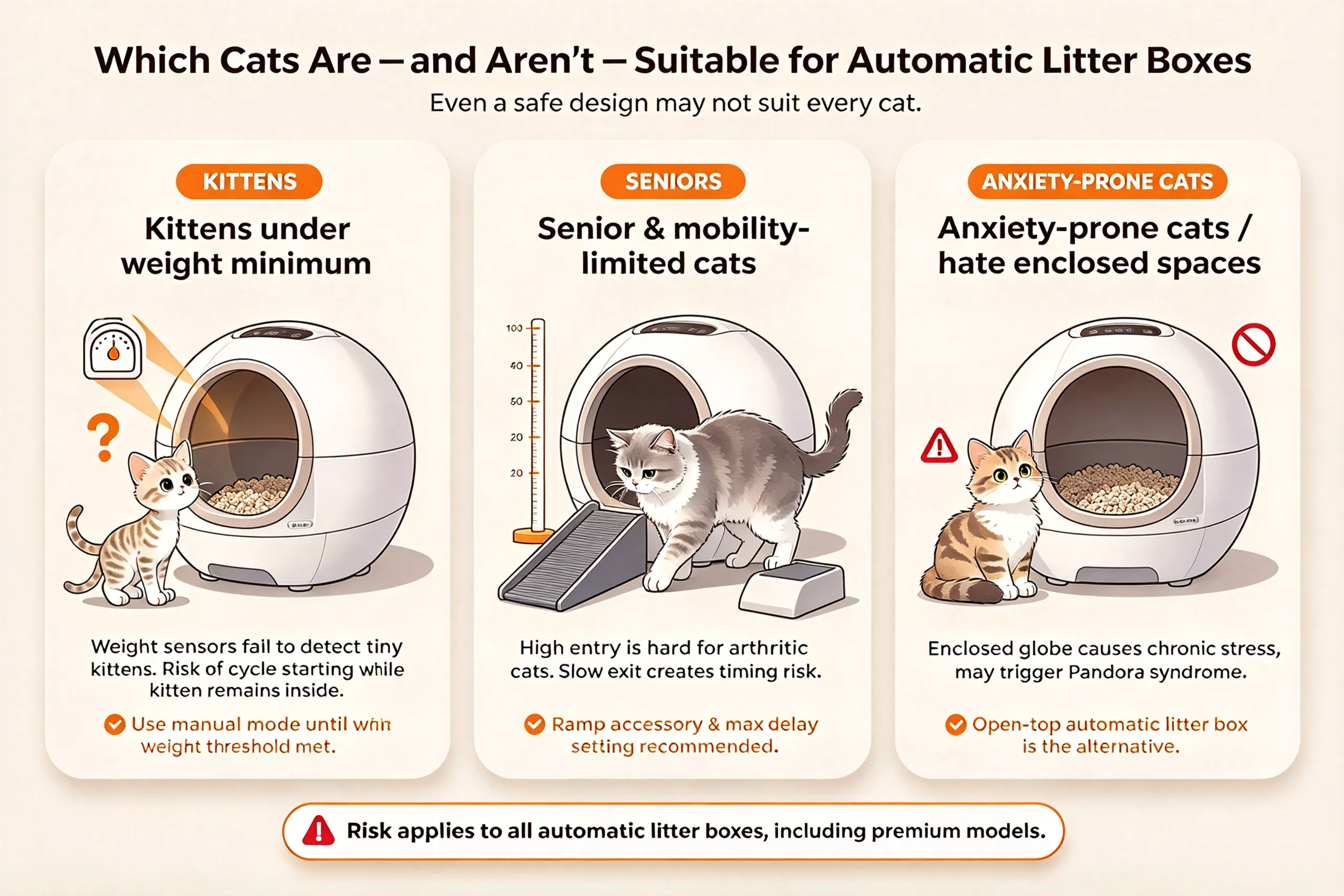
Even a safe design with all four safety features above is not appropriate for every cat. Three profiles present genuine suitability concerns that are about the cat’s physical state, not the machine’s design — and these concerns apply across all automatic litter boxes, including established premium units.
Kittens Under the Manufacturer’s Weight Minimum
Most automatic litter boxes use weight-based sensors to detect cat presence. These sensors have a minimum detection threshold — below which the sensor cannot reliably distinguish a cat’s presence from normal litter-mass variation. For the Litter-Robot 4, this threshold is approximately 3 lbs; the Litter-Robot 5 lowers it to approximately 2 lbs. A kitten below this threshold may not reliably trigger the sensor, meaning the cleaning cycle may begin while the kitten is still inside the globe.
The correct approach for kittens is semi-automatic or manual operation until the kitten consistently exceeds the sensor weight minimum — verified by the app’s cat weight tracking. In practice, most kittens reach 5 lbs at approximately 5 months of age; the sensor floor of 2–3 lbs corresponds to approximately 8–12 weeks. During the transition period, running the unit in manual mode (owner initiates the cycle after confirming the kitten has exited) eliminates the weight-floor risk entirely.
Senior and Mobility-Limited Cats: Entry Height and Exit Timing
The 7–8 inch entry height of most globe-style automatic litter boxes is too high for cats with significant arthritis or mobility limitations to step over comfortably or quickly. A slow-exiting senior cat who exits during the sensor detection window but moves slowly through the entry area may be adjacent to the mechanism when the cycle begins. Extending the cycle delay to the maximum available setting (20–30 minutes) addresses the timing concern for most senior cats. Our senior cat litter box guide covers the entry height problem and ramp accessory solutions in detail — the ramp converts a 7-inch step into a walkable incline that eliminates the entry challenge for arthritic cats.
Anxiety-Prone Cats and Enclosed-Space Aversion
Cats with existing enclosed-space aversion — those who avoid covered litter boxes, hide in open rather than enclosed spaces, or show stress responses in confined environments — are not good candidates for enclosed globe-style automatic designs. Forcing an anxious cat to use an enclosed automatic box risks producing Pandora syndrome (feline idiopathic cystitis driven by chronic stress) — the same stress-related condition that sometimes motivates owners to upgrade to a self-cleaning box in the first place. Open-top automatic designs address this by removing the enclosed chamber entirely: the cat positions in an open bowl with full sightlines and exit routes.
Introduction Protocol: How Setup Affects Safety Outcomes
A safely designed automatic litter box set up incorrectly produces worse outcomes than a standard box set up correctly. The introduction protocol determines whether a cat accepts the new box or develops avoidance that compounds over time. Our guide to cats who won’t use the automatic litter box covers the full introduction process — the summary relevant to safety is: introduce in manual mode alongside the existing traditional box, never remove the traditional box until the cat is voluntarily using the automatic unit, and extend the cycle delay beyond the default for any cat who exits slowly or re-enters quickly.
The Health Monitoring Benefit: The Safety Upside Most Owners Don't Consider
The safety conversation about automatic litter boxes focuses almost entirely on entrapment risk. The safety benefit that receives far less attention is the health monitoring capability of app-connected units — particularly relevant for senior cats and multi-cat households where individual cat behaviour changes are difficult to attribute.
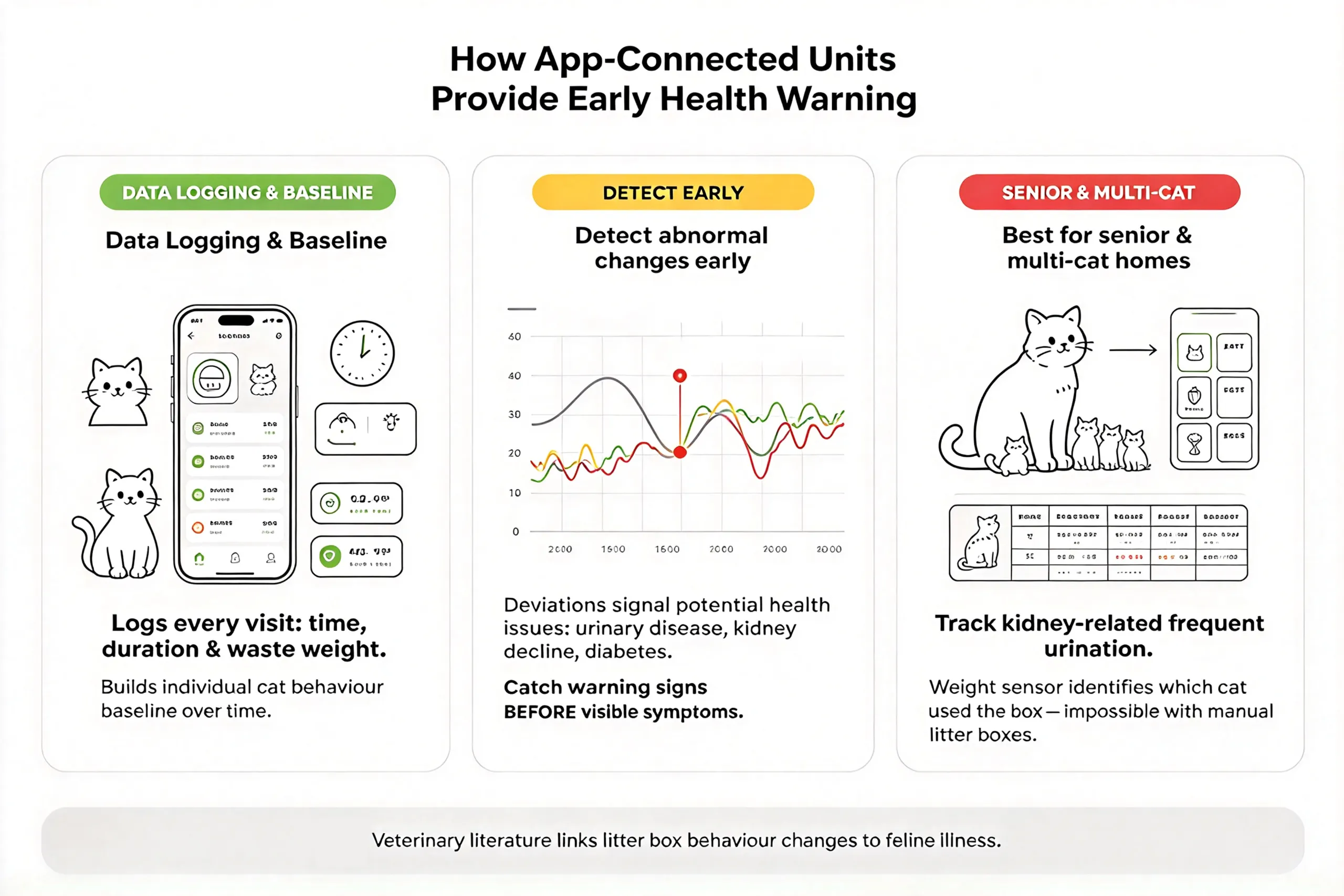
How App-Connected Units Provide Early Health Warning
App-connected automatic litter boxes log every visit: time, duration, and estimated waste weight. Over days and weeks, this builds a per-cat baseline. Deviations from that baseline — increased visit frequency with shorter duration, extended visit time with reduced output, sudden weight change — are associated with urinary tract disease, kidney function decline, and diabetes in the veterinary literature. These conditions produce detectable changes in litter box behaviour days before they become clinically obvious to an owner watching the box.
For senior cats specifically, litter box health monitoring is one of the most practical benefits of an automatic unit. A senior cat whose kidney function is declining will urinate more frequently in smaller volumes — a pattern that is immediately visible in app visit data but nearly impossible to track reliably with a manually-managed box, particularly in a multi-cat household where attributing visits to a specific cat is impossible without weight-based individual identification.
The Manufacturer's Perspective: Sensor Fail-Safe Architecture as the Non-Negotiable Safety Specification
The incidents documented in the Sphynxlair safety thread and the subsequent lawsuits have a common root that is visible at the manufacturing specification level: fail-active sensor default state combined with a closing-entry design. In 16 years of designing and manufacturing automatic litter box mechanisms, the sensor fail-safe architecture is the specification we treat as non-negotiable — not because of regulatory requirement (there is no mandatory entrapment safety standard for cat litter boxes in the US or EU), but because the consequence of getting it wrong is catastrophic and the engineering solution is straightforward.
A fail-safe system defaults to safe when a sensor produces an ambiguous or out-of-range reading. A fail-active system defaults to active. For a closing-door automatic litter box with a single infrared sensor, the failure mode of the sensor (dust accumulation on the lens, calibration drift, power fluctuation) produces a false ‘cat has exited’ reading. A fail-active system responds by starting the mechanism. A fail-safe system responds by holding the mechanism until the reading is resolved. The cost difference between these two architectures at the component level is negligible. The safety outcome difference is the difference between the incidents described in this article and no incidents.
The over-torque protector in the Litter-Robot 4 is the physical embodiment of fail-safe design: it does not rely on any sensor being correct — it responds to the physical reality of resistance against the mechanism. This is the correct engineering approach to a safety-critical system that operates unsupervised overnight in proximity to animals that cannot protect themselves from a mechanical failure. At AITAKON, we require documented fail-safe default state and physical backup protection from every automatic litter box design in our OEM programme. These are standard specification requirements — not premium options. For brands developing private-label automatic litter boxes, these specifications should be negotiated in writing at the design stage. Our OEM guide for automatic litter boxes covers the specific questions to ask any supplier about sensor fail-safe architecture.
Frequently Asked Questions
For most healthy adult cats using established globe-style units from reputable manufacturers, yes. The documented feline fatalities all involve a specific design type: vertical-rotation (Y-axis) automatic litter boxes with a closing entry hole, sold under unbranded or low-brand Amazon listings including 'Amztoy.' Globe-style units from Whisker (Litter-Robot 4 and 5) use horizontal rotation, a permanently open entry, and a physical over-torque protector that stops and reverses the motor if any resistance is detected — making entrapment impossible even in the event of complete sensor failure. Three cat profiles are not suitable for any automatic litter box regardless of design quality: kittens under the manufacturer's stated weight minimum, cats with significant enclosed-space anxiety, and senior cats with significant mobility limitations (without a ramp accessory and extended cycle delay).
Yes — in documented incidents involving a specific design. Multiple feline deaths have been attributed to vertical-rotation automatic litter boxes with closing entry mechanisms, primarily the Amztoy-branded model sold on Amazon (since removed) and the Autoscooper 11 (subject of a $3 million lawsuit filed in June 2025, ongoing as of September 2026). These incidents share a common mechanism: a single sensor system with a fail-active default state, combined with a closing-door entry, produced entrapment when the sensor failed to detect the cat during rotation. No comparable documented incidents involving Whisker Litter-Robot 4 or 5 mechanisms are known at time of publication. The incidents are design-specific, not category-wide — the correct response is to identify the dangerous design characteristics (vertical rotation, closing entry, single sensor, no physical backup) and avoid them, not to avoid automatic litter boxes as a category.
The safest automatic litter box designs share four properties: an open-entry design that never closes during the cleaning cycle; a physical over-torque or motor-stall protector that stops and reverses the motor if resistance is detected, independent of sensor state; dual-sensor detection requiring both weight and motion/laser sensors to register cat-exit before the cycle begins; and a configurable cycle delay of at least 3 minutes. The Litter-Robot 4 and Litter-Robot 5 from Whisker meet all four criteria and have an established track record. Open-top automatic designs (where the cat positions in an open bowl rather than an enclosed globe) additionally eliminate the enclosed-space concern and are suitable for cats that find globe-style units aversive. For any unit under consideration: confirm the four safety properties in the manufacturer's published specification before purchasing, not from the product listing description alone.
Not in automatic mode below the manufacturer's stated weight minimum — typically 2–3 lbs depending on the model. Most weight-based sensors have a minimum detection threshold; a kitten below this weight may not reliably trigger the sensor, allowing the cleaning cycle to begin while the kitten is still inside. The recommended approach: use the unit in manual mode (owner initiates the cycle after observing the kitten exit) until the kitten consistently exceeds the sensor weight minimum, confirmed by the app's cat weight tracking. At approximately 5 months of age, most kittens reach 5 lbs — well above any current automatic litter box's sensor floor. Introduce gradually, starting in manual mode alongside the existing traditional box, and monitor the first several automatic cycles closely.
The documented fatalities involved a specific failure sequence: a vertical-rotation (Y-axis) automatic litter box with a closing entry hole, a single infrared sensor that paused the cycle for only a brief time after detecting a cat, and a fail-active default state that resumed the cycle automatically after the sensor pause regardless of whether the cat had fully exited. When the sensor failed to reliably detect the cat's position — because of sensor quality, the brevity of the pause, or a cat partially in the entry — the mechanism resumed rotation with the cat in the path of the closing entry. The design was first documented by TikTok user @Carli_Jay after her cat Mochi's death; a firmware update lengthened the sensor pause but did not eliminate the closing-entry design. Reputable globe-style units avoid this failure mode entirely through: horizontal-axis rotation (entry never closes), physical over-torque protection (motor stops on any resistance regardless of sensor state), and dual-sensor redundancy (both weight and laser sensors must register exit before the cycle timer starts).




